
Patient-Centered Care Tools: A Game-Changer for Hospitals
Nurses and hospital administrators know the reality of modern healthcare: it is a race against the clock. Between charting, administering medications, coordinating with specialists, and managing admissions, the “care” in healthcare can sometimes feel like a secondary priority to the “tasks.”
Yet, the industry is shifting. The demand for patient-centered care—where the patient is an active partner rather than a passive recipient—is louder than ever. This isn’t just about warm feelings; it’s about hard metrics. Hospital Consumer Assessment of Healthcare Providers and Systems (HCAHPS) scores, patient satisfaction scores, readmission rates, and clinical outcomes all hinge on how involved and satisfied a patient feels during their stay.
The challenge? Finding the time to foster that connection. This is where patient-centered care tools, including effective patient communication boards, come into play. These technologies and solutions bridge the gap between clinical efficiency and human connection, ensuring that patients remain at the center of the journey without adding to the administrative burden of the staff.
The Patient Care Pain Points: Why We Need a Change
For hospital administrators, low patient satisfaction scores are a red flag for reputation and reimbursement. For nurses, the pain is more personal. It’s the frustration of answering the same question five times because a family member feels out of the loop. It’s the guilt of rushing out of a room because another patient is buzzing.
The root cause often isn’t a lack of caring, but a lack of infrastructure to support patient engagement and effective patient communication. When we rely solely on verbal communication in a high-stress environment, details get lost. Patients feel detached, anxiety rises, and satisfaction plummets. Poor communication contributes to gaps in care coordination and increases the risk of medical errors. Patient engagement tools and communication boards are designed to solve exactly this by systematizing the way we connect and educate patients.

Patient-Centered Communication: Basic Tools
To understand which tools provide the most value, we must first look at the skills they are meant to support. Effective nurse-patient communication strategies rely on specific fundamentals. Here is a breakdown of the essential skills required for true patient-centeredness, and how gaps in these areas hurt the patient experience.
1. Transparency and Clarity
Patients are often thrust into a foreign environment filled with medical jargon and uncertainty. A basic skill of patient-centered care is removing that mystery. Transparency means the patient knows who is caring for them, what the plan is for the day, and what their pain management goals are. Without this, patients feel a lack of control, leading to anxiety and repeated call-light usage.
2. Encouraging Active Involvement
Communication should be a two-way street. It is not enough to tell a patient what is happening; they must be invited to participate. This skill involves asking patients, “What is your goal for today?” or “Do you have questions about this medication?” When patients are passive, they are less likely to adhere to treatment plans, leading to poorer health outcomes.
3. Consistency Across Shifts
One of the biggest complaints in HCAHPS surveys is receiving conflicting information. True patient-centered communication requires consistency. The message from the night shift must match the message from the day shift. When this chain breaks, trust is eroded instantly, negatively impacting patient satisfaction.
4. Emotional Support and Empathy
Beyond clinical data, patients need to feel seen as people. This skill is often the first to suffer during a busy shift. However, tools that handle the “data” side of communication free up nurses to focus on the “human” side—providing the empathy and reassurance that machines cannot.
The Tools That Change the Game
Knowing the skills is one thing; executing them during a 12-hour shift with six patients is another. This is where patient-centered care tools become a game-changer. They act as a force multiplier for the nursing staff, automating information sharing and enhancing the patient experience.
Here are the essential tools transforming hospitals today:
Bedside Communication Boards
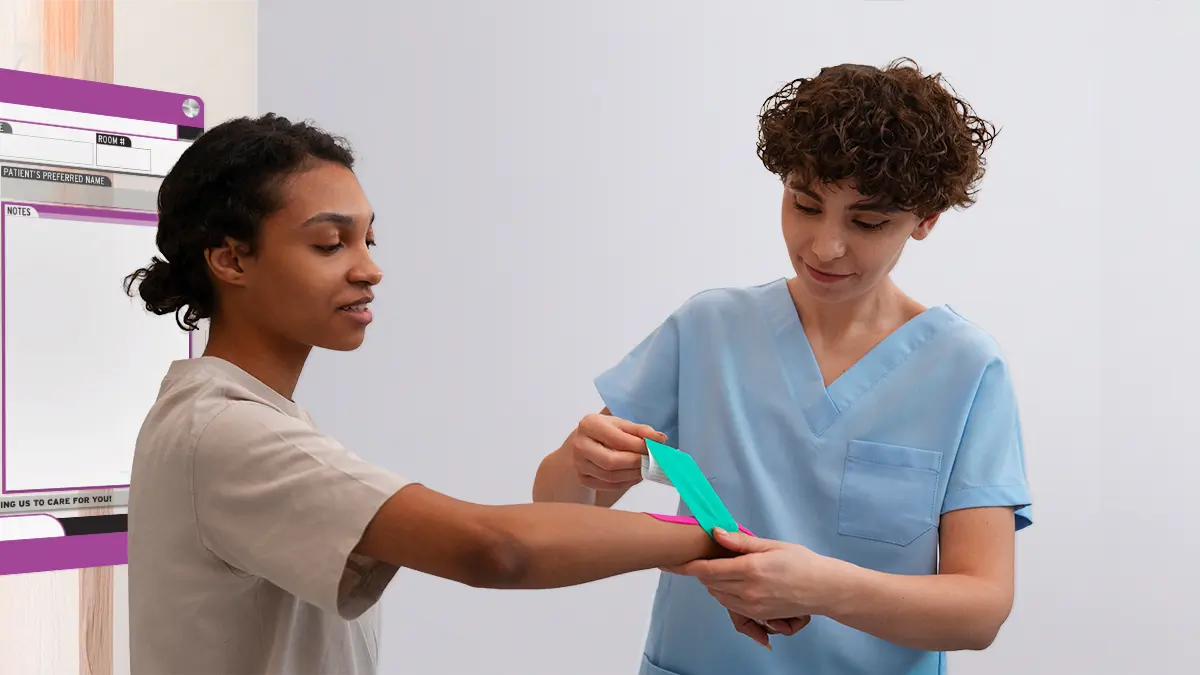
Visual communication in healthcare is one of the most effective ways to improve clarity, patient education, and retention. Patient communication boards, especially bedside whiteboards, serve as the “source of truth” in the patient room.
Unlike a verbal update that can be forgotten, a whiteboard provides a constant visual reference. It displays the care team’s names, daily goals, pain scores, and discharge plans. For the patient, this board provides a sense of control and reduces anxiety. For the nurse, it reduces repetitive questions and ensures that family members are informed even if they step out of the room. It transforms the wall of a hospital room into a dynamic engagement and education tool that supports better care coordination and helps close care gaps.
Digital Patient Engagement Tools
Modern hospitals are increasingly adopting digital patient engagement tools such as bedside tablets or interactive TV systems. These platforms allow patients to access their health records, view educational videos about their condition, and even order meals.
By putting this power in the patient’s hands, hospitals directly address the pain point of “lack of involvement.” A patient who can watch a video on wound care at their own pace is more informed and better prepared for discharge. These patient experience enhancements significantly boost health literacy and make the patient feel like an active participant in their recovery.
Real-Time Feedback and Rounding Solutions
Waiting for HCAHPS surveys weeks after discharge is too late to fix a bad experience. Digital rounding tools allow nurse managers to capture feedback in real-time. These patient satisfaction solutions help staff identify unhappy patients immediately—perhaps the room is too cold, or a medication was delayed—and resolve the issue before the patient leaves. This proactive approach turns potential detractors into promoters and shows patients that their voice matters now, not just as a data point later.
Integrating Tools into Strategy
Implementing these tools is not just about hanging boards or buying tablets; it is about integrating them into nurse-patient communication strategies.
For example, a “board updating” protocol should be part of the bedside shift report. When nurses update the patient communication boards together in front of the patient, it reinforces consistency (Skill #3) and transparency (Skill #1).
Similarly, introducing a digital education video on a tablet can be the catalyst for a “teach-back” moment, where the nurse asks the patient to explain what they learned. This validates understanding and ensures active involvement (Skill #2).
Care Coordination with Skills and Tools
The shift toward patient-centered care is not a passing trend; it is the future of medicine. However, asking nurses to “communicate better” without giving them the resources to do so is a recipe for burnout.
By investing in the right patient-centered care tools, including patient communication boards and digital engagement platforms, hospitals can alleviate the burden on their staff while simultaneously elevating the patient experience. Whether through high-tech digital platforms or high-impact visual communication in healthcare like whiteboards, these tools turn passive patients into engaged partners. For hospital administrators and nurses alike, that is the ultimate win-win.
Comment (1)
Comments are closed.
The Psychology of Patient Engagement: How Communication Boards Build Trust | VisiCare
January 22, 2026[…] boards also promote patient centered care by involving patients in their own care plans and encouraging active participation. When patients […]