
7 Ways Bedside Communication Transforms Patient Experience for Nurse Patient Communication Strategies
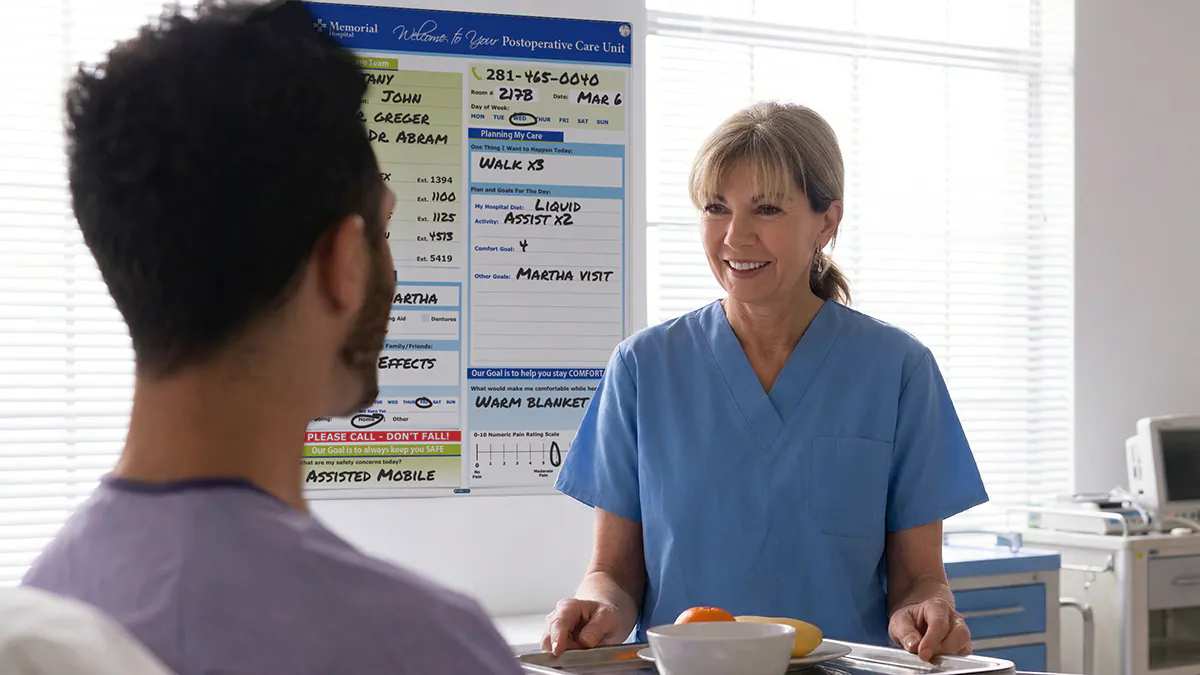
Walk into almost any hospital room and you’ll find a whiteboard on the wall. But here’s the uncomfortable truth: in many facilities, that board sits blank—or worse, it’s filled with outdated information from a previous shift. Meanwhile, patients lie in their beds uncertain about who’s caring for them, when they’ll be discharged, or what their care plan even involves.
Patient involvement in healthcare is a minimum requirement for person-centered care. Communication boards are developed with the intention to enhance patients’ ability to participate in their care and gain more control over their healthcare journey.
This communication gap has real consequences. In person care consistently shows that patients who feel uninformed are less satisfied, less engaged in their own care, and more likely to be readmitted after discharge. For hospital administrators already navigating staffing pressures, tightening budgets, and Patient Survey scrutiny, this is a problem worth solving. Improving patient satisfaction requires a proactive approach that addresses communication and personalization.
Bedside communication boards—purpose-designed, customizable visual tools mounted in patient rooms—offer a proven, cost-effective solution. When used correctly, these boards do far more than display a date and a nurse’s name. They actively shape the patient experience, support nurse-patient communication, and drive measurable improvements in patient satisfaction scores. While there are costs associated with implementing new tools, the benefits in patient satisfaction and trust far outweigh them.
What Are Bedside Communication Boards?
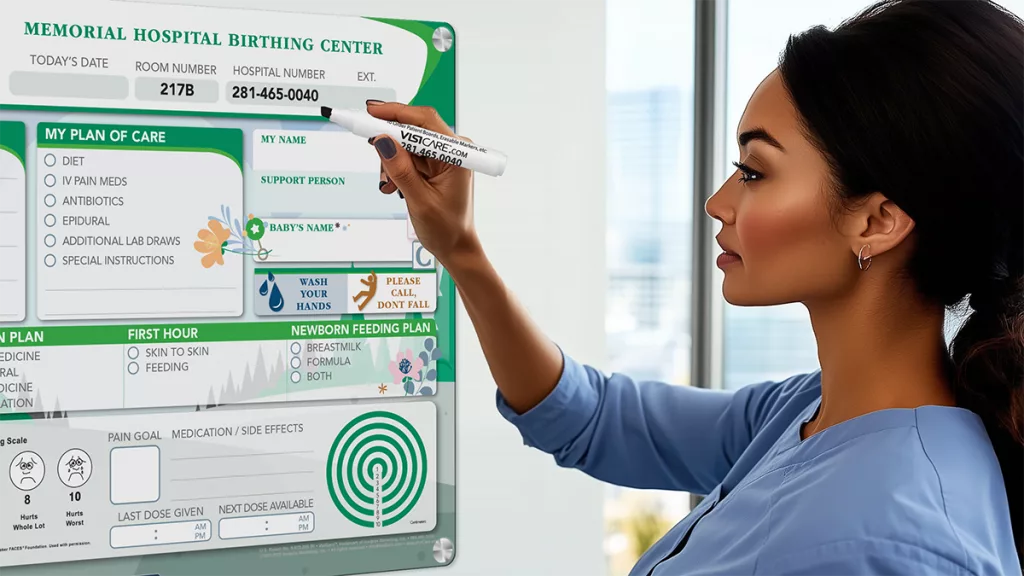
Bedside communication boards are structured, dry-erase tools mounted in patient rooms, designed specifically for clinical communication. Unlike a generic whiteboard, these are purpose-built patient communication tools with dedicated sections for daily care goals, care team names, scheduled procedures, pain scores, anticipated discharge dates, and patient questions.
They come in a range of formats to suit different budgets and environments: traditional dry-erase whiteboards, premium tempered glass boards (such as VisiCare™ Glass Boards), acrylic plexi boards, and interactive digital boards. Many can be customized for specific departments—ICU, obstetrics, behavioral health, med-surg—and configured with multilingual graphic inserts to support limited English proficiency (LEP) patients. Communication boards can also be developed for specific healthcare organizations and tailored for children, young people, and other stakeholders, ensuring that systems and practices are adapted to meet diverse needs. Person-centered care tools include standards, educational tools, practical work tools, and evaluation tools, and some of these tools have been developed in collaboration with university research. Tools for education and learning in person-centered care can be implemented with simple means, such as Post-it notes and group discussions.
Research consistently shows these boards do far more than display static information. Used strategically, they are active drivers of patient-centered care.
7 Ways Bedside Communication Boards Improve Patient Experience
1. Strengthening Nurse-Patient Communication
Verbal communication alone has a critical flaw: patients forget it. Under stress, anxiety, or the influence of medication, retaining spoken information is difficult. Bedside communication boards serve as a persistent, visible reference point that reinforces what’s been discussed.
Effective nurse-patient communication improves safety and satisfaction through active listening, empathy, and clear, jargon-free language. Ongoing training in bedside manner is essential for nurses to enhance patient satisfaction. Improving nurses’ knowledge and communication skills through structured training can reduce medical errors and enhance patient safety.
For nursing staff already stretched thin, this matters operationally too. Boards reduce the need to repeat information across shifts, freeing nurses to focus on higher-value care tasks.
2. Boosting Patient Satisfaction Scores
Under value-based care models, patient satisfaction is often linked to reimbursement, making it a priority for both clinical care and financial health. Implementing best practices and structured evaluation methods can help increase patient satisfaction by ensuring communication strategies are effective and patient-centered. Many healthcare administrators have observed improvements in patient satisfaction scores after implementing whiteboard communication tools. Effective patient communication boards can lead to higher patient satisfaction scores by engaging patients and their families in the care process. Anecdotally, patients frequently express appreciation for seeing clear daily goals and having their care team information readily accessible on these boards, which helps them feel more engaged and informed during their hospital stay. While formal studies are ongoing, these practical experiences suggest that bedside communication boards can play a valuable role in enhancing patient satisfaction in healthcare settings.
3. Helping Patients Identify Their Care Team
Few things erode patient trust faster than not knowing who is responsible for their care. Patients frequently cannot name their attending physician or primary nurse—not because they don’t care, but because no one has clearly told them.
Communication boards support patients’ ability to recall care team information, while integrated systems help ensure all stakeholders—including healthcare professionals, patients, and administrators—are aligned in providing clear, consistent communication.
Many healthcare administrators have observed improvements in patient satisfaction scores after implementing whiteboard communication tools. Patients frequently express appreciation for seeing clear daily goals and having their care team information readily accessible on these boards, which helps them feel more engaged and informed during their hospital stay. Although formal studies are ongoing, these practical experiences suggest that bedside communication boards can play a valuable role in enhancing patient satisfaction in healthcare settings.
4. Engaging Patients in Their Own Care Plan
Patients who understand their care plan are more compliant, more satisfied, and less likely to return to the hospital after discharge. Bedside whiteboards create a shared reference point that invites patients into the conversation rather than leaving them on the sidelines.
Communication boards empower patients to take more control of their care and support self management, reflecting the intention to foster active patient involvement, which is a minimum requirement for person-centered care.
Many healthcare administrators have observed improvements in patient satisfaction scores after implementing whiteboard communication tools. Patients often express appreciation for seeing clear daily goals and having their care team information readily accessible on these boards, which helps them feel more engaged and informed during their hospital stay. Although formal studies are ongoing, these practical experiences suggest that bedside communication boards can play a valuable role in enhancing patient satisfaction in healthcare settings.
5. Improving Discharge Planning and Reducing Readmissions
Patients who know their anticipated discharge date take a more proactive role in preparing for it. They arrange transportation sooner, ask the right questions, and engage more meaningfully with discharge instructions. This translates directly into faster throughput and fewer last-minute complications.
Communication boards can also be used to share knowledge about discharge planning and treatments, ensuring patients and staff are informed and aligned. Additionally, evaluation tools can help assess the effectiveness of these interventions, supporting continuous improvement in nurse patient communication strategies.
Many healthcare administrators have observed improvements in patient satisfaction scores after implementing whiteboard communication tools. Patients frequently express appreciation for seeing clear daily goals and having their care team information readily accessible on these boards, which helps them feel more engaged and informed during their hospital stay.
6. Supporting Pain Management Transparency
Uncertainty around pain management is a significant source of patient anxiety. When patients can see their pain score, scheduled medication times, and care team’s plan on the board, they know what to expect—and that clarity reduces distress.
Communication boards can also display diagnosis information and leverage systems to track and communicate pain management plans, supporting person-centered conversations and improving patient preparation and understanding.
Many healthcare administrators have reported improvements in patient satisfaction scores after implementing whiteboard communication tools. Patients often express appreciation for seeing clear daily goals and having their care team information readily accessible on these boards, which helps them feel more engaged and informed during their hospital stay.
7. Enhancing Education and Health Literacy
A bedside communication board can double as a patient education tool—and the research supports this application. Patients have reported that whiteboards add significant value to their education. Hand-drawn anatomical diagrams on whiteboards have also been shown to positively impact patient understanding. For example, nurses can use communication boards to illustrate procedures or care plans, making complex information easier for patients to grasp. Patients often express that having clear daily goals and visible care team information on these boards helps them feel more engaged and informed during their hospital stay.
There are also free digital tools available to support patient education and health literacy, including resources designed for children and young people. Reviewing medical records alongside communication boards can help ensure consistency and accuracy in patient education. Patient education is a powerful nursing intervention that pays many long-term dividends, and using the teach-back method enhances patient comprehension and closes the communication gap between nurses and patients.
This is especially impactful for LEP patients. Boards with interchangeable bilingual graphic inserts allow care teams to communicate in a patient’s native language without replacing the entire board. Hospitals can also develop condition-specific educational templates for common diagnoses, making patient education more consistent across staff and reducing the time required to prepare it.
Quality Outcomes: Measuring the Impact of Communication Boards
When we work with healthcare organizations who are truly committed to delivering exceptional patient care, we know that measuring quality outcomes isn’t just important—it’s everything. That’s where patient communication boards come in, and honestly, they’ve become one of our favorite tools for transforming the patient experience. Think of them as your daily conversation starter with patients, creating a clear, welcoming space where care goals, pain management plans, and daily updates become part of an ongoing dialogue. We’ve seen how these boards empower patients to step up and take an active role in their care, building that transparent communication bridge between patients and healthcare teams that makes all the difference.
Here’s what gets us excited: we’ve watched study after study demonstrate real, measurable improvements when healthcare teams embrace these communication tools. We’re talking about better patient satisfaction scores, fewer readmission rates, and more effective pain management—results that speak for themselves. Our approach helps healthcare organizations tap into those valuable insights from patient feedback and satisfaction surveys, giving you a clear picture of how your communication boards are performing and where you can make them even better. When we prioritize that transparent communication and genuinely listen to our patients, we create an environment where people feel heard, informed, and truly engaged—and that’s where both patient experience and quality outcomes really shine.
We believe that integrating patient communication boards into your daily practice isn’t just about checking a box—it’s about fostering a culture where continuous improvement feels natural and achievable. Our experience shows that healthcare organizations who embrace this approach don’t just meet their quality goals; they exceed them while creating genuine connections that enhance patient satisfaction and drive better health outcomes for everyone involved.

Active Listening: Fostering Deeper Patient Connections
Here’s what we love about active listening in patient care—it’s truly the foundation of everything we do, and communication boards? They’re like having a dedicated conversation starter that never gets overlooked. When we invite patients to share what’s really on their minds through these boards, we’re essentially saying, “Your voice matters, and we’re here to listen.” It’s this kind of genuine attention that shows patients we’re committed to understanding what truly matters to each person who walks through our doors.
And here’s the beautiful thing—this approach doesn’t just make patients feel better (though it absolutely does that). We’re actually seeing improved health outcomes and those genuinely positive experiences that make our work so rewarding. Think about it: when we use these boards to clear up confusion, answer those important questions, and create care plans that feel personal rather than one-size-fits-all, we’re building real trust. Patients start to feel like active partners in their own care journey, which is exactly where we want them to be. Plus, we get to spot potential concerns early and respond quickly—it’s like having an early warning system that helps us tailor our approach to each unique situation.
By making communication boards a central part of how we care for people, we’re creating something special—an environment where patients feel genuinely valued and empowered. It’s this kind of thoughtful approach that strengthens those crucial patient-provider relationships and, ultimately, leads to the better outcomes we’re all working toward. When patients feel heard and understood, everyone wins.
Healthcare Facility and Patient Experience: Organization-Wide Benefits
Think of patient communication boards as your facility’s secret weapon for creating that warm, connected feeling patients crave. When you roll these tools out across your entire healthcare organization, you’re not just putting up boards—you’re weaving together a consistent, patient-centered experience that touches every corner of your facility. It’s like having a friendly guide in every room, helping patients feel heard, informed, and genuinely cared for throughout their journey.
Here’s what we love seeing when healthcare teams embrace communication boards facility-wide: those patient satisfaction scores start climbing, patients become loyal advocates for your organization, and your reputation for excellence really starts to shine. But here’s the beautiful part—these boards don’t just make patients happy. They become this amazing collaboration tool that gets your healthcare professionals talking to each other more effectively, streamlines all that important communication, and honestly? They help catch potential errors before they happen. It’s like having a safety net that also happens to make everything run smoother.
When you invest in patient communication boards across your facility, you’re making a statement—one that says patient safety and quality outcomes aren’t just priorities, they’re who you are. We’ve seen how organization-wide adoption helps healthcare facilities not only meet those regulatory requirements (which, let’s be honest, can feel overwhelming), but also positions them as true leaders in patient-centered care. At the end of the day, communication boards are more than just tools—they’re your strategic partner in delivering both operational excellence and those outstanding patient experiences that people remember and talk about.
What Makes an Effective Bedside Communication Board?
Not all boards deliver equal results. High-performing communication boards share several key characteristics:
- Structured layout: Dedicated sections for daily goals, care team names, pain management, scheduled procedures, and discharge dates—not a blank surface left to individual interpretation
- Durability and hygiene: Non-porous surfaces that resist staining and ghosting, designed for the rigorous cleaning protocols of clinical environments
- Customization: Department-specific layouts, multilingual capability, and the option to update graphic inserts as policies evolve or facilities rebrand. Boards can be tailored to include specific details and intended outcomes for each department or patient group.
- Positioning and access: Boards should be visible from the patient’s bed and patients should be actively invited to write on and engage with the board—not just receive information passively
- Shared staff ownership: Upkeep should be distributed across the care team, including attending physicians, nurses, and therapists, rather than placed solely on nursing staff
VisiCare™ offers a full range of board styles—Glass, White, Plexi, Safety, and Digital—designed specifically for healthcare environments with customization, hygiene, and durability built in. Following best practices in board design and use ensures that the intended benefits for patient communication and satisfaction are achieved.
Common Barriers to Implementation (and How to Overcome Them)
Even well-intentioned implementations stall. Here are the most common obstacles and practical ways to address them:
- Staff time and upkeep: Distribute ownership across the care team. When maintenance is a shared responsibility—not a nursing task—boards stay current and accurate. While there are costs associated with implementation, the return on investment is demonstrated by positive feedback from customers who report improved communication and satisfaction.
- Patient awareness: Train staff to orient patients to the board at the start of every shift. A 60-second introduction makes a measurable difference in engagement. Ongoing training is essential to ensure staff are confident and effective in using communication boards to their full potential.
- Standardization: Work with vendors like VisiCare™ to design facility-specific graphic layouts that prompt consistent, structured use across departments.
- Clinical jargon: Keep board language plain and patient-friendly. Abbreviations that are second nature to clinicians are often confusing to patients and families.
Interchangeable graphic inserts simplify updates as policies change—no need to replace the entire board when layouts or branding evolve. Regular evaluation of communication board effectiveness helps identify areas for improvement and ensures continued value for both patients and healthcare organizations.
Upgrade Your Patient Communication Strategy
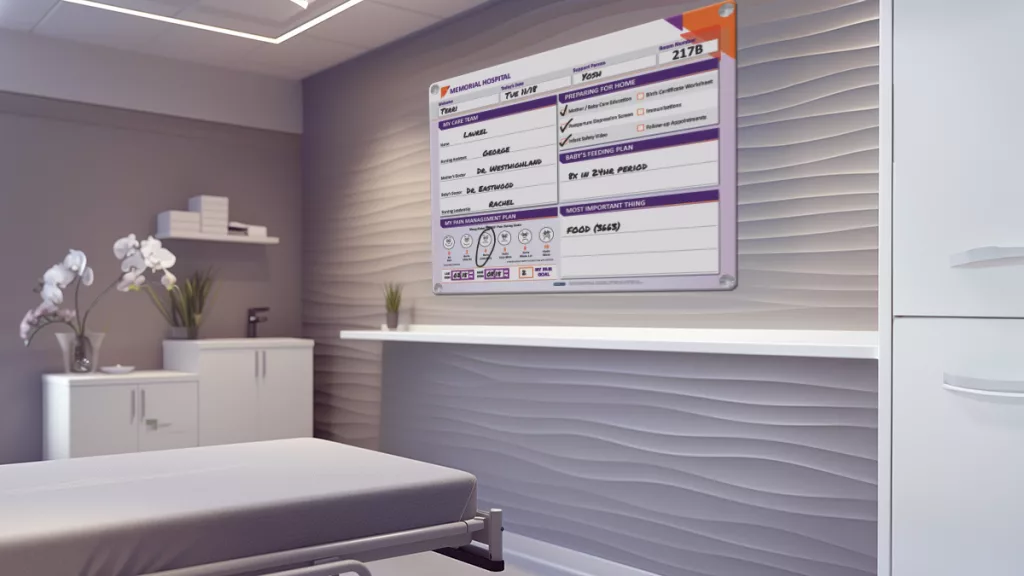
The evidence is clear. Bedside communication boards are a cost-effective, evidence-based patient engagement tool that measurably improves satisfaction scores, provider identification, care plan engagement, pain transparency, discharge planning, and health literacy—all from a single, well-placed board in every patient room. There are different ways communication boards can be implemented depending on the needs of each healthcare organization.
For healthcare administrators looking to close communication gaps, support nursing staff, and move the needle on Patient Survey performance such as HCAHPS, this is one of the highest-ROI improvements available. Healthcare systems must leverage every resource available to deliver the highest quality of care. The question isn’t whether to implement them—it’s how to implement them well.
Explore VisiCare™’s full range of customizable patient communication board solutions, designed for every unit type and built for the realities of clinical environments. Talk to our team about designing a solution tailored to your facility.
Frequently Asked Questions
What should be on a bedside communication board?
At minimum, an effective board should include the patient’s daily care goals, care team names (nurse, physician, therapist), scheduled procedures, pain score and medication schedule, and anticipated discharge date. A section for patient questions further deepens engagement. Following best practices and using structured systems, such as SBAR, can enhance the effectiveness of communication boards.
How do whiteboards improve patient satisfaction (HCAHPS)?
Research shows that structured whiteboard use significantly improves the HCAHPS communication domains—particularly nurse and doctor communication. The “goal of the day” and patient engagement sections have been identified as the strongest predictors of overall satisfaction scores. Evaluation tools and ongoing training help ensure that staff have the knowledge and skills needed to use communication boards effectively.
What’s the difference between a regular whiteboard and a bedside communication board?
A standard whiteboard is a blank surface. A bedside communication board is a purpose-designed patient communication tool with structured sections, customizable layouts, hygienic surfaces suited to clinical environments, and options for multilingual inserts—all designed to support consistent, standardized patient communication. Using plain language, maintaining an open posture, and making intentional eye contact are important practices for effective communication.
Are communication boards suitable for behavioral health and high-risk units?
Yes. Specialized options like VisiCare™ Safety Boards are designed for high-risk environments, featuring ligature-resistant construction, rounded corners, and single-piece designs—while retaining full communication board functionality.