
How Interactive Patient Care Boosts Engagement and Outcomes
A patient lies in bed, unsure who their nurse is, what tests come next, or when they might go home. Down the hall, that same uncertainty repeats in room after room—and your nurses answer the same questions all shift long. It’s draining. It pulls skilled clinicians away from the bedside work only they can do. And it quietly chips away at the patient outcomes every nurse and administrator is fighting to improve, including improving patient satisfaction.
There’s a better way to close that gap. Interactive patient care boosts engagement and supports stronger outcomes without piling more onto your team. The key is how you frame the technology: smart patient room technology and digital boards work for your nurses and healthcare teams. They surface the right information at the right moment so your people spend more time on care that matters. They support clinical decisions—your team makes the call. These tools also facilitate communication with family members and support collecting satisfaction surveys to continuously enhance the care experience.
This article draws on helping hospital teams put bedside engagement tools to work the right way. Let’s look at what actually drives engagement, how it connects to outcomes, and how to choose a platform that fits your facility.
What Really Drives Patient Engagement
Patient engagement isn’t a buzzword. It’s a clinical outcome. When patients understand their care plan, participate in decisions, and feel connected to their team and family members, the results show up where you measure them—better adherence, fewer unanswered questions, higher satisfaction scores, and more meaningful satisfaction surveys.
The evidence backs this up. Research on patient activation links more engaged patients to better outcomes and lower costs (Health Affairs). National guidance treats patient and family engagement as a core safety and quality priority, not an optional extra (AHRQ).
So what holds engagement back? Usually the same communication gaps:
- Care plans that aren’t clear to the patient
- Updates that never reach the bedside
- Confusion about who’s on the care team and how family members fit in
- Call lights flooded with non-urgent requests
Each gap strains your nurses, frustrates patients and families, and reduces workflow efficiency. And here’s the part worth repeating: nurses sit at the center of engagement. They build it through communication, education, and trust. The right tools don’t replace that work—they remove the friction around it so nurses can do what they do best.
Start here: Pinpoint one engagement gap on your unit. That’s the first thing the right tools can help you close.
How to Improve Patient Outcomes
Strong engagement leads to better outcomes through a clear, practical pathway. Interactive patient care systems display care goals, schedules, team names, and discharge milestones in plain, real-time language. That clarity lowers patient anxiety and helps people take part in their own care.
It also supports safer, smoother care. Prompts for pain reassessment, rounding, and fall-risk awareness give nurses helpful confirmation tools—never automated decisions. Clear communication is tied directly to safety in established quality standards (The Joint Commission), and communication quality feeds straight into the measures that shape your reputation and reimbursement (CMS HCAHPS).
There’s an efficiency payoff, too. Interactive patient care solutions for hospitals cut repetitive questions and low-priority call lights, returning time to the bedside. The system simply reflects decisions your team has already made. Your nurses stay in control.
Try this: List the three questions patients ask most on your floor. Those are the first things a system can help answer.
Smart Patient Room Technology in Practice
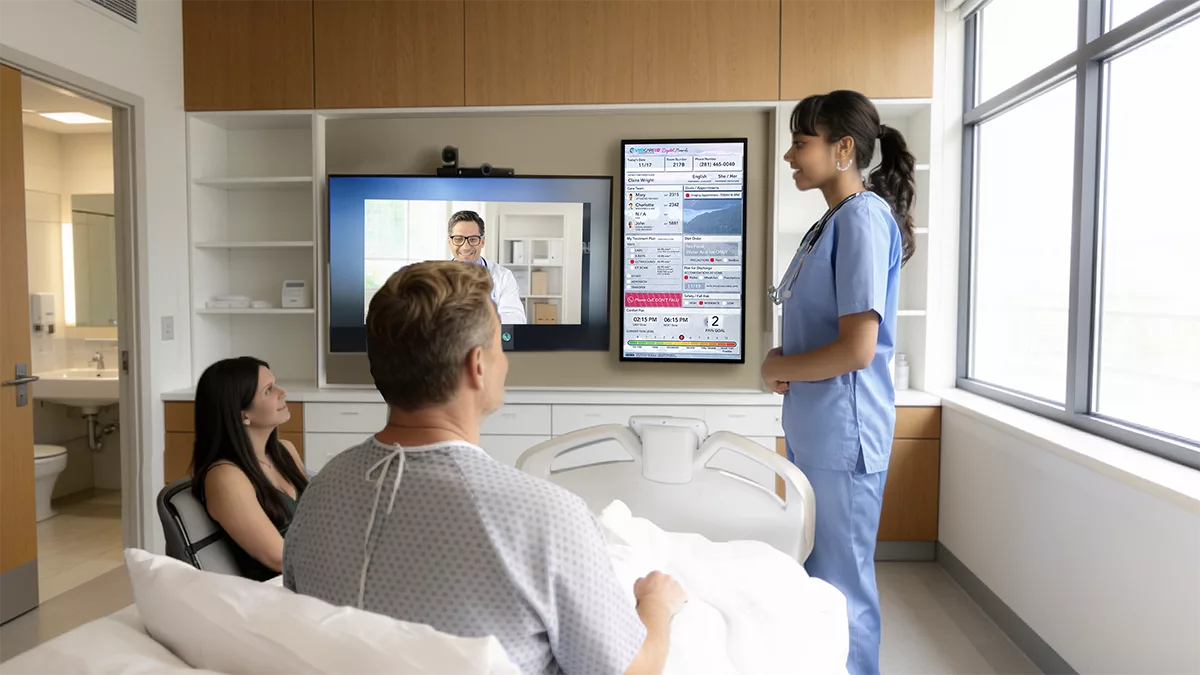
It helps to make this tangible. A smart patient room isn’t a sci-fi setup. It’s a digital board showing the current care plan, an interactive display patients can use for non-urgent updates—all controlled by your nurses, who decide what appears and when.
Digital vs. analog patient communication boards
Digital patient communication boards offer real-time updates, seamless integration with clinical workflows, and accessibility features that keep patients informed and engaged throughout their care journey. They empower healthcare professionals to deliver timely information, and educational resources, enhancing understanding and improving patient outcomes. Digital boards reduce the administrative burden on healthcare staff by automating routine updates and requests, fostering efficient hospital operations and better care coordination.
On the other hand, custom dry erase glass boards provide a tangible, flexible solution that healthcare providers can personalize to reflect specific care processes and patient needs. Their sleek design supports clear, legible communication and can be updated instantly in room by caregivers, promoting effective communication and patient comfort.
Both digital and custom dry erase glass boards overcome gaps of the blank analog boards—outdated, static surfaces that fail to support dynamic care processes or patient engagement. Unlike these empty boards, which contribute to miscommunication and workflow delays, digital and custom glass boards actively integrate into the clinical workflow, supporting healthcare teams in delivering coordinated, patient-centered care.
Accessibility and inclusion in the patient experience
Good engagement reaches every patient. Large text, multiple languages, and simple navigation matter for older adults, patients with limited mobility, and non-English speakers. Accessibility isn’t a nice-to-have—it’s part of equitable care and aligns with federal accessibility expectations (Section 508).
And once more, the principle that anchors everything: smart patient room technology flags, displays, and reminds. Your nurses and care team decide.
Map it: Walk one patient room and note what information a board could keep current automatically.
Choosing the Best Interactive Patient Care Platform
A consistent decision process keeps emotion and vendor hype in check. Use these five lenses to compare options on equal footing.
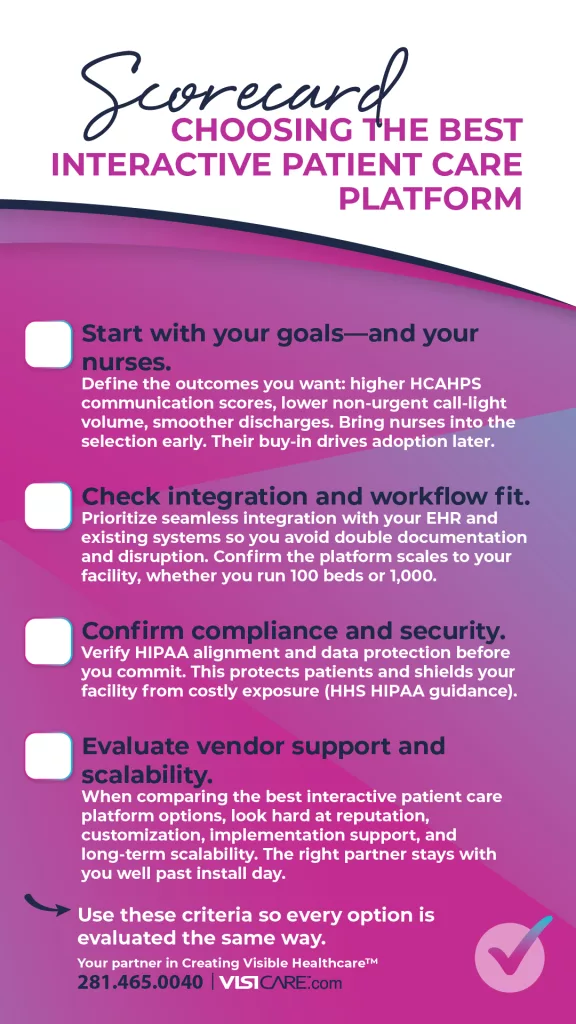
Start with your goals—and your nurses. Define the outcomes you want: higher HCAHPS communication scores, lower non-urgent call-light volume, smoother discharges. Bring frontline nurses into the selection early. Their buy-in drives adoption later.
Check integration and workflow fit. Prioritize seamless integration with your EHR and existing systems so you avoid double documentation and disruption. Confirm the platform scales to your facility, whether you run 100 beds or 1,000.
Confirm compliance and security. Verify HIPAA alignment and data protection before you commit. This protects patients and shields your facility from costly exposure (HHS HIPAA guidance).
Evaluate vendor support and scalability. When comparing the best interactive patient care platform options, look hard at reputation, customization, implementation support, and long-term scalability. The right partner stays with you well past install day.
Make it concrete: Use this short scorecard from these four criteria so every option gets judged the same way.
Quick Checklist for Stronger Engagement
Keep this close as you move forward:
- Identify your biggest communication gaps.
- Set outcome goals with nurse input.
- Confirm EHR and smart room technology integration.
- Prioritize usability for staff and patients.
- Verify HIPAA compliance and data security.
- Compare vendors on support and scalability.
- Track baseline metrics and review them regularly.
- Keep clinical judgment—not the board—at the center.
Bringing Patient Satisfaction and Operational Efficiency together
The throughline is simple: engaged patients lead to better outcomes, and the right tools help your nurses build that engagement. Interactive patient care systems and smart room technology succeed when they support skilled teams—never when they try to stand in for them.
Nurse and staff involvement and clear goals drive both adoption and results. Start small, measure your progress, and expand what works. Let your biggest communication gap guide the first step.
To see how interactive patient care can support your nurses and your patients, explore the approach and resources at VisiCare.com—designed around your team, never in place of it.