
Choosing the Best Hospital Communication Boards for Patient Rooms
Quick answer: Hospital communication boards are wall-mounted whiteboards or digital displays in patient rooms that show care plans, daily goals, and care team names. The best ones are durable, customizable to your unit’s workflow, easy for staff to update, and—for digital models—integrated with your EMR.
Communication failures play a role in a significant share of serious medical errors. The Joint Commission has long cited breakdowns in communication as one of the most common root causes of sentinel events. When information about a patient’s care doesn’t flow clearly between nurses, physicians, patients, and families, the risks add up fast—missed medications, duplicated tests, longer stays, and frustrated patients.
That’s why something as simple as a board on the wall matters so much. Clear patient room communication is tied directly to the outcomes hospital leaders track most closely: patient safety, satisfaction scores, and overall care quality. A well-designed board keeps everyone on the same page, literally.
Hospital communication boards offer a proven, cost-effective way to close those gaps. For hospital administrators, clinical managers, and directors of nursing weighing a purchase, this guide covers what these boards are, why they matter, which features to prioritize, and how to roll them out so staff actually use them.
What Are Hospital Communication Boards?
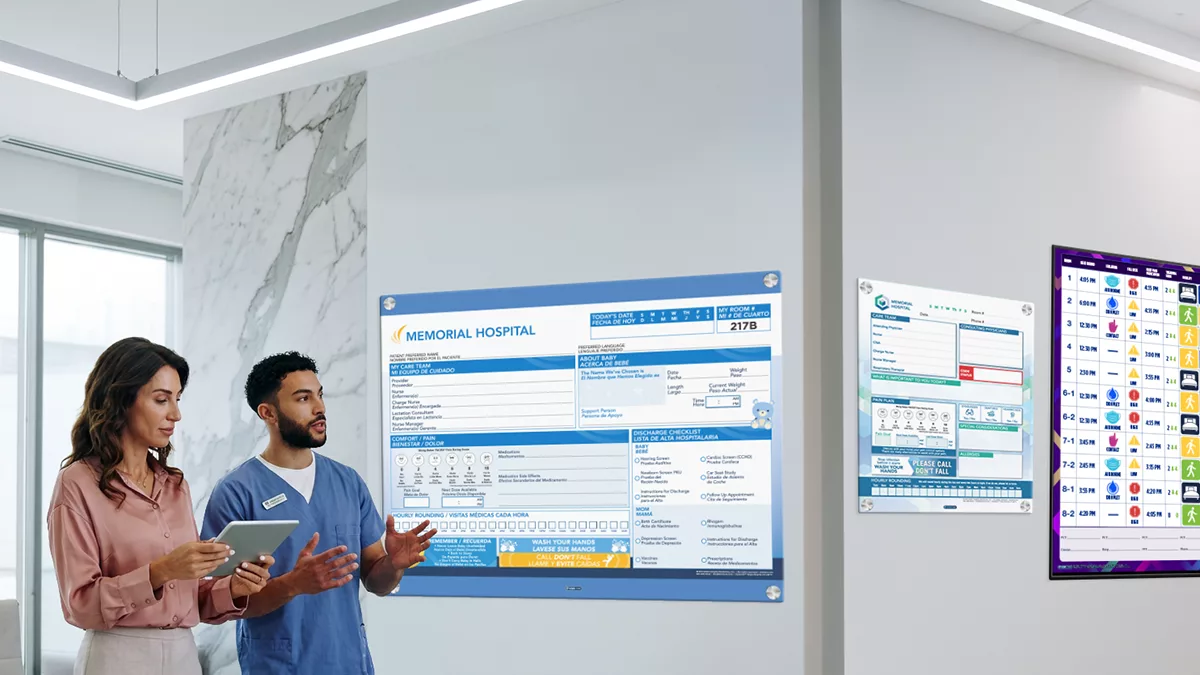
Hospital communication boards are display tools mounted in patient rooms to share key care information at a glance. You’ll hear them called by several names: patient room communication boards, patient care boards, nurse communication boards, or simply patient information boards. Whatever the label, the purpose is the same—keep patients, families, and care teams aligned.
Types of Boards: Whiteboards, Digital, and Hybrid
There are three main approaches to choose from:
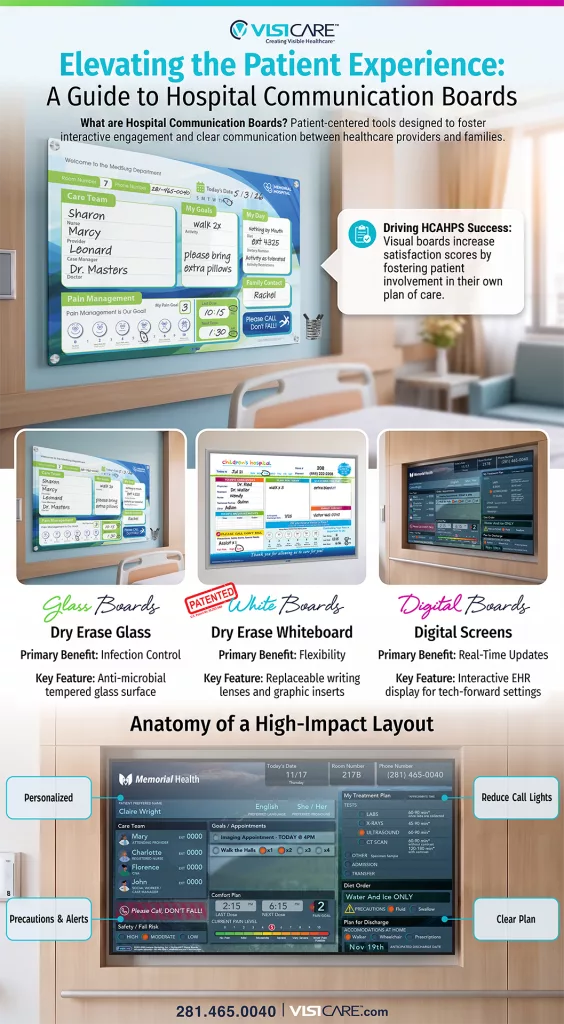
- Dry Erase whiteboards: Dry-erase boards updated by hand. Affordable, simple, and familiar to staff.
- Dry Erase glass boards: modern material for modern infection control
- Digital screens: Electronic displays that pull and push information automatically, often connected to hospital systems.
Each option fits a different budget and workflow, which we’ll compare in detail later.
Key Functions of a Patient Care Board
A good patient information board does more than list a room number. Core uses include:
- Displaying patient information (name, date, care team)
- Outlining the care plan and daily goals
- Supporting nurse-to-patient and nurse-to-nurse communication
- Giving patients and families space to write questions and notes
- Listing pain goals, mobility status, and anticipated discharge date
A simple sample layout might divide the board into four quadrants: Today’s Date & Care Team at the top left, Daily Goals at the top right, Schedule & Tests at the bottom left, and Questions for My Care Team at the bottom right.
Why Hospital Communication Boards Are Essential for Patient Rooms
These boards punch well above their weight. Here’s how they support the goals that matter most to clinical leaders.
Enhanced Patient Safety
A clearly written board reduces the chance of errors slipping through the cracks. When medications, allergies, and care goals are visible to everyone in the room, patients and families can catch discrepancies, and staff can confirm details quickly. That visibility supports better medication adherence and fewer preventable mistakes.
Improved Patient Satisfaction
Patients feel more in control when they understand their own care. A board that names the nurse on shift and spells out the day’s plan reduces anxiety and invites questions. This kind of engagement consistently shows up in higher patient satisfaction scores—a metric tied directly to reimbursement under value-based care.
Streamlined Staff Workflow
Nurses and care teams spend less time hunting for information when it lives in one consistent place. A standardized board closes communication gaps between shifts and disciplines, so handoffs go smoother and fewer details get lost.
Better Patient Outcomes
Coordinated care leads to timely interventions. When the whole team shares a single source of truth at the bedside, decisions happen faster and follow-through improves—both of which translate into measurable results.
Meeting Regulatory Standards
Communication boards align with patient-centered care expectations from accrediting bodies and support compliance efforts around patient engagement and safety. Choosing materials and designs that meet infection-control and HIPAA considerations keeps your facility on the right side of the rules.
A worthwhile proof point: because whiteboard and hybrid boards require minimal ongoing cost while supporting safety and satisfaction gains, they routinely deliver strong ROI relative to their modest upfront investment.
Key Features to Look for in the Best Hospital Communication Boards
Use this checklist during procurement to compare options quickly:
- Durability and cleanliness: Surfaces that withstand frequent disinfection and support infection control.
- Customization options: Layouts tailored to departmental needs and hospital branding.
- Visibility and readability: Large fonts, strong color contrast, and placement patients can see from bed.
- Ease of use for staff: Intuitive design that needs little training to update.
- Patient engagement features: Dedicated space for patient questions and family notes.
- EMR integration (digital boards): Seamless data flow with Electronic Medical Records to reduce manual entry.
The closer a board maps to these criteria, the more likely your staff will adopt it and your patients will benefit.

Custom vs. Template Boards: Why One-Size-Fits-All Often Fails
Off-the-shelf boards are tempting because they’re quick and cheap. But there’s a catch.
The Limits of Templates
Some vendors offer standard, ready-made boards. These work fine in a pinch, but a generic layout rarely matches the specific workflow of a specialized unit. Fields go unused, important details have no home, and staff start writing in the margins—defeating the purpose.
The Power of Customization
A custom-designed board lets you tailor fields, branding, and layout to a unit’s exact protocols. An ICU board can prioritize ventilator settings and sedation goals, while a Maternity board highlights feeding plans and newborn details. Choose custom when departmental workflows differ enough that a shared template would slow your team down.
Long-Term Value
Custom boards earn their keep over time. When a board reflects how a unit actually works, staff adopt it, workarounds disappear, and the board becomes a genuine part of the care process rather than a static wall fixture. That adoption is where the real return on investment shows up.
How to Implement Hospital Communication Boards Effectively
Buying the board is only half the job. Rollout determines whether it sticks.
- Assess your needs first: Identify specific departmental requirements before you purchase, not after.
- Build staff training and buy-in: Involve nurses early and keep training short. High adoption depends on staff feeling the board helps them, not adds work.
- Mind placement and accessibility: Position the board where patients can read it from bed and staff can update it easily. Boards should be placed within the patient’s line of sight and readable from the bed to maximize their effectiveness.
- Review and update regularly: Boards lose value the moment they go stale. Build updates into shift routines and audit accuracy periodically.
Use Cases Across Specialty Departments
Hospitals across different units have used communication boards to drive real improvement:
- ICU: Standardized boards that display sedation goals and daily care plans help teams coordinate complex care and reduce miscommunication during high-stakes handoffs.
- Pediatrics: Boards with child-friendly layouts and family note sections ease anxiety for young patients and parents, supporting stronger engagement.
- Surgical units: Boards listing procedure details, mobility goals, and discharge targets keep recovery on track and help patients understand each step.
When facilities measure the impact—tracking error rates, handoff quality, and satisfaction scores before and after—the boards consistently prove their worth as a low-cost, high-value tool.
The Future of Patient Room Communication
Clear communication at the bedside isn’t a nice-to-have. It’s directly tied to patient safety, satisfaction, and the outcomes your facility is measured on. The right hospital communication boards close gaps, empower patients, and make your staff’s day run smoother—all for a modest investment.
The smartest next step is to audit what you have now. Look at the boards in your patient rooms and ask whether they match how your teams actually work. If they don’t, it’s worth exploring customizable, compliant solutions built around your units’ specific needs. A board designed for your workflow—not a generic template—is the one your staff will use and your patients will appreciate.
Hospital Digital Patient Boards Buyer’s Guide 2027: Essential Checklist
When selecting digital patient boards for your hospital in 2027, consider the following key criteria to ensure you choose the best solution for your healthcare setting:
- EMR Integration
- Seamless connection with your Electronic Medical Records system for real-time data updates.
- Automatic syncing of patient information such as care plans, medication schedules, and allergies.
- User-Friendly Interface
- Intuitive display that healthcare professionals and patients can easily visually navigate.
- Clear visibility from the patient’s bed.
- Customization and Flexibility
- Ability to tailor board layouts to different departments (ICU, Pediatrics, Surgical units).
- Modular custom designs that support specialty workflows and branding.
- Real-Time Updates and NotificationsFull time display of important information including:
- Fall risk alerts
- Pain management status
- Daily goals
- Security and Compliance
- HIPAA-compliant data handling to protect patient privacy.
- Secure access controls for staff to prevent unauthorized changes.
- Durability and Maintenance
- Robust hardware designed for healthcare environments with easy cleaning and infection control.
- Reliable software with vendor support and regular layout updates to maintain your protocols.
- Patient Engagement Features
- Care team names
- Doctor contact info
- Progress updates to increase patient satisfaction
- Support for Fall Prevention and Safety
- Integration of fall risk indicators and safety protocols.
- Visuals to assist healthcare professionals in maintaining patient safety.
- Implementation and Training
- Vendor-provided training and onboarding support for hospital staff.
- Easy integration into existing hospital workflows to maximize adoption.
- Scalability and Future-Proofing
- Ability to expand system capabilities as hospital needs evolve.
- Compatibility with emerging healthcare technologies and standards.
- Cost and ROI
- Transparent pricing including hardware, software, and maintenance.
- Proven impact on increasing patient satisfaction, reducing patient falls, and improving HCAHPS scores.
Use this checklist as a guide to evaluate digital patient board solutions that will enhance communication, improve patient experience, and support your hospital’s goals in 2027 and beyond.
Frequently Asked Questions
What should hospitals look for in patient communication boards?
Prioritize durability for frequent cleaning, readability from the bed, easy updating for staff, customization to your unit’s workflow, and space for patient questions. For digital boards, EMR integration is key to reducing manual data entry.
Are digital or whiteboard communication boards better for hospitals?
Whiteboards are best for budget-conscious units that value simplicity and need no IT support. Digital boards suit high-acuity, tech-ready hospitals that need real-time updates and EMR integration. Hybrid boards offer a middle ground.
How much do hospital communication boards cost?
Traditional whiteboards are the most affordable, with low upfront and ongoing costs. Digital displays cost more initially and require technical support, but offer automation. Custom boards cost more than templates but typically deliver higher adoption and ROI.
Why choose a custom board over a standard template?
Standard boards from vendors rarely fit specialized workflows, leading to unused fields and staff workarounds. Custom boards match a unit’s exact protocols—ICU versus Maternity, for example—which improves adoption and long-term value.
How do communication boards improve patient safety?
By making medications, allergies, care goals, and the care team visible to everyone in the room, boards help patients and families catch discrepancies and let staff confirm details quickly. This supports medication adherence and reduces preventable errors.
Who is responsible for updating patient room communication boards?
Nurses usually update the boards during shift changes and rounds. With custom boards that have a printed layout, updating is quick and easy. The clear design helps staff fill in information fast, making sure everything stays accurate and up to date.