

Medical Whiteboards: Materials, Durability, and Infection Control
Medical whiteboards often look fine on installation day. The trouble shows up later. Within a few years, a poorly matched surface can ghost, stain, scratch, or break down under hospital-grade disinfectants. Care information becomes harder to read, and infection prevention teams start asking questions.
The surface material plays a large role in that outcome. It affects how long a board stays readable, how safely it can be cleaned, and how consistent it looks from one department to the next. This guide expands on the “durable, cleanable surfaces” trait. It gives procurement teams and hospital leaders a clear, practical look at what each material can do.
What you’ll learn:
- How melamine, glass, and acrylic surfaces differ, in plain terms
- How each material holds up to daily clinical use
- How surface choice affects cleaning and infection control
- How materials affect readability over a board’s life
- Why a shared materials standard supports standardized communication across departments
Why Material Choice Matters for Medical Whiteboards
Material choice can look like a minor detail on a purchase order. In a clinical setting, it shapes how well a board does its job, and for how long.
The Operational Risks of the Wrong Surface
When a surface isn’t suited to clinical use, problems build over time:
- Ghosting leaves old names, goals, or plans faintly visible. That can confuse patients and staff about which information is current.
- Stains and scratches trap residue. They also make a board look unclean to patients and families, even right after it has been wiped.
- Chemical damage forces a hard trade-off. Environmental services (EVS) teams must choose between following cleaning protocols and protecting the board.
- Early failures pull boards off walls before their time. Replacement then disrupts the unit.
Each of these issues affects communication, the patient experience, and the workload of the staff who rely on the boards.
The Three Requirements Every Clinical Surface Must Meet
The rest of this guide judges each material against three clinical requirements:
- Durability: resists impact, scratching, ghosting, and wear from constant use
- Readability: keeps handwriting and printed fields clear and high-contrast over time
- Infection control: tolerates frequent disinfection without damage and gives residue no place to collect
A fourth consideration works at the system level: consistency. A material that performs the same way in every department supports a unified communication system.
Key takeaway: Material isn’t a cosmetic choice. It decides whether a board can do its clinical job for its full service life.
Understanding the Three Main Medical Whiteboard Surfaces
Most hospital boards use one of three surface materials. Each has a distinct structure, and that structure drives how it performs.
Melamine
Melamine is a resin coating bonded to a backing, often hardboard or particleboard. It is familiar, lightweight, and widely available, which makes it a common choice for general-use boards.
The surface is more porous than glass, so ink and residue can settle in over time. Melamine can also be sensitive to harsh chemicals. Choosing an alternate whiteboard with components other than Melamine gives a cost effective choice without the draw basks, such as the patented VisiCare™ White Board.
Glass Dry Erase Boards
Medical glass boards are typically made from tempered safety glass. Tempered glass is heat-treated for strength. If it does break, it shatters into small, blunt pieces instead of sharp shards.
Glass boards are often back-painted or printed on the reverse side. That gives them a nonporous writing surface, strong resistance to stains and ghosting, and graphics protected behind the glass. Options include magnetic glass boards for holding cards or notices and colored glass boards for color-coded systems. Learn more about glass dry erase boards.
Acrylic and Plexiglass
Acrylic is a rigid plastic sheet that can be clear or colored. “Plexiglass” is a common name for acrylic.
Acrylic is lighter than glass and shatter-resistant. It supports second-surface printing, meaning graphics are printed on the back of the sheet so markers and wipes never touch the ink. Acrylic does scratch more easily than glass, and some cleaners can damage it. Clear acrylic is often used for overlays and inserts. Explore acrylic patient boards and clear dry-erase boards for more detail.

Durability: How Medical Whiteboards Hold Up to Clinical Use
Hospital walls take a beating. Durability determines whether a board survives that environment and still looks right years later.
Impact, Scratch, and Wear Resistance
Clinical boards face carts, beds, and equipment bumping into walls. They’re written on and erased many times per shift, then wiped down again and again.
Each material responds differently. Glass resists scratching and surface wear well. Acrylic holds up to impact but shows fine scratches more readily. Melamine coatings can wear thin in high-use areas. When it comes to breakage, glass and acrylic take different approaches. Tempered glass relies on strength and safe-break behavior, while acrylic relies on shatter resistance.
Dry Erase Ghosting and Staining Over Time
Ghosting is the faint marking left behind after you erase. It happens when ink settles into tiny openings in a surface.
The more porous the surface, the more likely ghosting and staining become. Nonporous glass releases ink cleanly. Acrylic also performs well, though scratches can hold ink. Melamine is the most prone to ghosting as its coating ages. Understanding why boards ghost helps teams set realistic expectations.
Protecting Pre-Printed Fields and Graphics
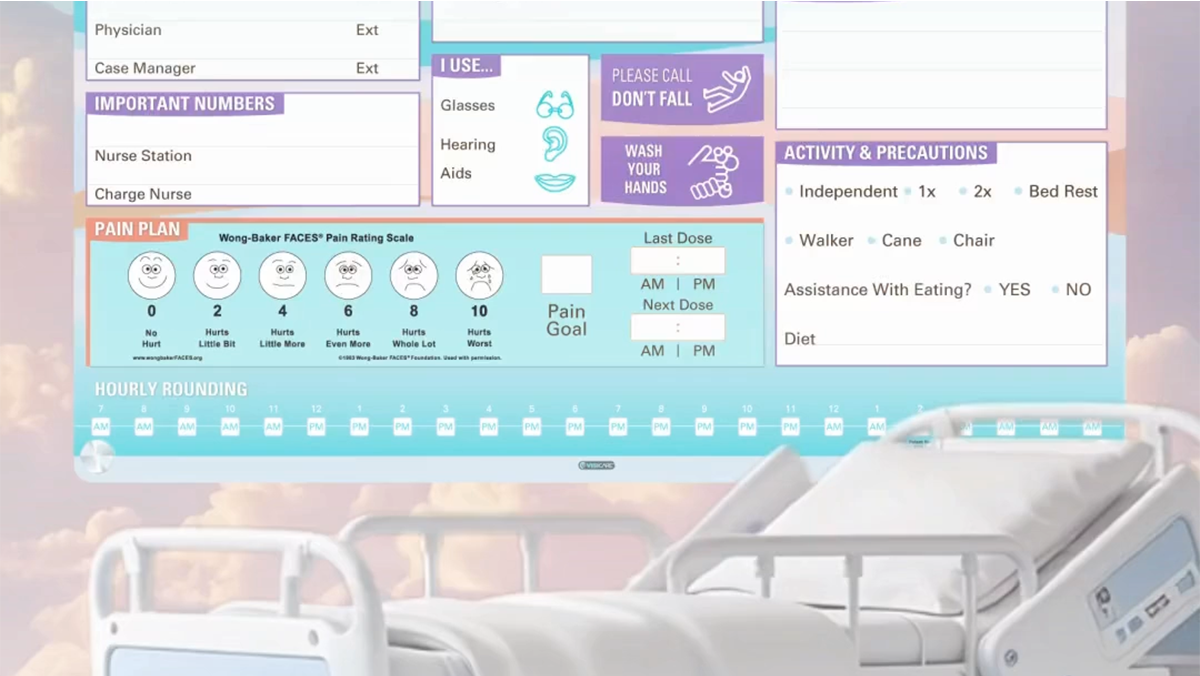
Patient boards depend on printed headings, logos, icons, pain scales, and other protected fields that may also include staff names and hospital logos. These elements need to stay sharp for years, not months, so patients and families can quickly identify key information and the right hospital staff.
Surface printing sits right where markers and wipes touch, so it fades with use. Protected printing behind glass or acrylic stays out of reach. This matters for standardization. Faded headings on one unit break visual consistency with the rest of the system. For print options, see our post on custom plexiglass boards.
| Durability Factor | VisiCare™ White Boards | VisiCare™ Glass Boards | VisiCare™ Plexi Boards |
|---|---|---|---|
| Impact resistance | Good | Better | Best |
| Scratch resistance | Good | Best | Good |
| Ghosting resistance | Good | Best | Better |
| Print protection | Good (graphic insert print) | Best (back-printed or insert) | Best (integrated print) |
Ratings are general and qualitative. Confirm performance against product specifications for any board you evaluate.
Key takeaway: Durability isn’t only about breakage. It’s about whether the board still looks and reads the same in year five as it did on day one.
Infection Control and Cleanability by Material
Infection prevention (IP) teams care about how a surface responds to the cleaning it will face every day. Here is how material choice supports those protocols.
Porous vs. Nonporous Surfaces
A nonporous surface has no tiny openings where residue or microorganisms can settle. A porous surface does. That is why IP teams generally prefer smooth, nonporous, easy-to-wipe surfaces in patient care areas.
No board material prevents infections on its own. The right surface simply makes it easier for staff to clean thoroughly and consistently, in support of your existing infection control protocols.
Disinfectant Compatibility
Hospitals rely on EPA-registered disinfectants, which the US Environmental Protection Agency approves for use on hard surfaces. Common types include quaternary ammonium compounds (“quats”), bleach, hydrogen peroxide, and alcohol-based wipes. The tolerance of materials to these chemicals varies significantly:
- Glass is generally the most chemically tolerant surface.
- Acrylic can develop fine surface cracks, called crazing, particularly with alcohol-based or solvent cleaners.
- Melamine coatings deteriorate more quickly with repeated use of harsh cleaning agents.
Key Reminder: Always refer to manufacturer cleaning guidance and your facility’s approved disinfectant list to confirm compatibility with board materials. Before purchase, request written cleaning instructions from the manufacturer for Environmental Services (EVS) and Infection Prevention (IP) teams to review.
Protecting Marker Performance: While disinfectants are necessary for infection control, always wipe down the cleaned surface with water after using a disinfectant. This step helps maintain the longevity of your dry erase markers, as chemical residues can impair marker performance over time.
Edges, Frames, and Mounting Points
Infection control extends beyond the writing surface. Seams, exposed edges, frame channels, and marker trays can all collect residue.
Frameless or sealed-edge designs reduce these collection points. When you compare options, look at how the full board is built, not just the face.
Bringing Infection Prevention Into the Material Decision
Involve IP and EVS teams early in the process. Their input ensures the material you choose fits the cleaning protocols already in place. It also prevents an awkward conflict after installation, when cleaning standards and board condition pull in opposite directions.
For cleaning procedures, see our guides on how to clean hospital whiteboards and cleaning glass boards.
Key takeaway: The right material lets EVS clean as often and as thoroughly as protocols require, without shortening the board’s life.
How Surface Material Affects Readability
A board only works if people can read it. The surface plays a bigger role in that than many buyers expect.
Contrast That Lasts
Readability depends on strong contrast between the writing and the surface. That contrast fades as surfaces ghost, stain, or yellow with age.
This makes long-term readability a durability outcome. When bedside whiteboards remain clear and patients have access to them, they often feel less anxious about their stay. Encouraging patients and families to engage with readable whiteboards can improve satisfaction and understanding. A surface that resists wear keeps names, goals, and printed fields easy to read for years.
Surface Reflectivity and Glare
Glossy surfaces can reflect overhead lights and window light, which makes writing harder to see from some angles. Matte finishes reduce that reflection.
Marker Performance by Surface
Ink behaves differently on each surface. Some surfaces show standard dry-erase markers more crisply than others, and some pair best with specific marker types. For more on the writing experience, see writing on glass boards.
Key takeaway: A readable board starts with a surface that keeps writing crisp and printed fields sharp for its full service life.
How Material Choice Supports Effective Communication and Standardized Communication Across Departments
Materials don’t just affect individual boards. They affect whether your entire communication system holds together.
Why Mixed Materials Undermine Consistency
When units buy boards on their own, the same layout can look and perform differently from floor to floor. Colors print differently on different surfaces. Some boards wear quickly while others hold up. Some ghost, while others stay clean.
That inconsistency erodes the shared visual language that standardized communication across departments depends on. It is especially hard on float pool and travel nurses, who need to find information quickly on every unit they work. Standardized layouts also improve provider identification and patient engagement for the care team. Well-organized boards consistently include sections for care team identification, daily goals, and safety alerts.
One System, Matched to Department Demands
The goal isn’t one product for every room. It’s matching material properties to department demands within a defined system.
| Department Demand | Material Property to Prioritize | Why It Matters for Consistency |
|---|---|---|
| High-traffic corridors and stations | Impact and scratch resistance | Boards stay intact and uniform despite heavy contact |
| Isolation and high-acuity areas | Disinfectant tolerance | Boards survive frequent cleaning without visible damage |
| Long-stay units | Ghosting resistance and print protection | Printed fields stay sharp over long stays and many updates |
A health system can approve a small, defined set of materials. Each one should reproduce the same layout, colors, and icons faithfully.
Building Materials Into Your Layout Library
Each approved graphic insert layout should also specify the approved material and print method. That way, a reorder two years from now matches the boards on your walls today.
For procurement teams, this brings clear benefits:
- Simpler, faster reorders
- Consistent appearance after expansions or acquisitions
- Fewer one-off purchases outside the system
Key takeaway: Standardizing materials keeps standardized layout looking and working the same in every department.
Next Steps
Material choice affects every board on every unit, and the effects last for years. Here’s what to remember:
- Surface material determines how long medical whiteboards stay durable and readable.
- Nonporous, chemically tolerant surfaces make infection control easier to sustain.
- Protected printing keeps pre-printed fields sharp over the board’s life.
- A defined materials standard keeps patient boards consistent across departments.
- Early input from IP and EVS teams prevents conflicts between cleaning and board condition.
VisiCare™ designs customizable, durable, and compliant communication boards for hospitals and health systems. Every board is backed by reliable support and clear product documentation, so your teams can make confident, informed decisions.
The best way to evaluate a surface is to see it, write on it, and clean it. Request material samples and cleaning compatibility documentation so your IP and EVS teams can review each option before you buy.
Frequently Asked Questions
What is the most cleanable surface for medical whiteboards?
Nonporous surfaces such as glass are generally the easiest to disinfect because residue has nowhere to settle. Always confirm compatibility with your facility’s approved disinfectants before purchasing.
Are glass boards safe for patient rooms?
Glass boards made from tempered safety glass are heat-treated for strength. If they break, they shatter into small, blunt pieces rather than sharp shards.
Can acrylic boards be cleaned with alcohol wipes?
Use caution. Some alcohol-based or solvent cleaners can cause crazing, which is a network of fine surface cracks. Check the manufacturer’s cleaning guidance first.
Why does ghosting happen on whiteboards?
Ghosting happens when ink settles into tiny openings in a porous surface and doesn’t fully erase. For removal tips, see our guide on how to clean hospital whiteboards.