

How Hospital Whiteboards Strengthen Nurse-Patient Communication
Quick answer: Patient whiteboards strengthen nurse-patient communication by giving patients, families, and staff a single, visible reference for care team names, daily goals, and plans. They support continuity across shifts, help patients with language barriers, and are linked to higher HCAHPS communication scores and stronger patient engagement.
Shift changes, rotating providers, and a constant stream of medical information can leave patients confused about who is caring for them and what comes next. For the nurses managing it all, those same factors make consistent communication difficult to maintain. A simple, well-used patient whiteboard helps close that gap—turning a blank wall into a tool that keeps everyone aligned.
Strong nurse-patient communication does more than reassure patients. It directly supports patient safety, drives satisfaction, and influences how a hospital performs on the HCAHPS patient survey. The challenge for many facilities isn’t a lack of effort—it’s a lack of consistent, visible information that patients and staff can rely on.
This post explains where communication breaks down in hospital care, the specific ways patient room whiteboards bridge those gaps, and how clinical leaders can maximize their impact across units.
The Communication Gap in Patient Care
Hospital communication is rarely the result of a single conversation. Instead, it’s spread across a fragmented care team—nurses, physicians, patient care technicians, and specialists—who rotate in and out across multiple shifts. Each handoff is an opportunity for details to get lost.
Three realities make this especially difficult:
- Fragmented care teams: Patients may interact with a dozen or more staff members in a single day, making it hard to remember who is responsible for what.
- Language barriers: Patients with limited English proficiency may struggle to follow verbal updates, increasing the risk of misunderstanding.
- Information overload: Between medications, tests, and care plans, patients are asked to absorb a tremendous amount of information while feeling unwell.
These gaps carry real consequences. When patients can’t track their own care, they feel anxious and disengaged. When incoming staff lack a quick reference point, continuity suffers—and so does safety.
How Patient Whiteboards Bridge the Gap
Bedside communication tools work because they make critical information visible and constant. Research supports this: Goyal et al. (BMJ Qual Saf, 2020) studied patient and nurse perspectives and found that bedside whiteboards can enhance communication when they’re used consistently and kept current.
Here’s how patient room whiteboards strengthen nurse-patient communication day to day.
A Consistent Visual Reference for Patient Information
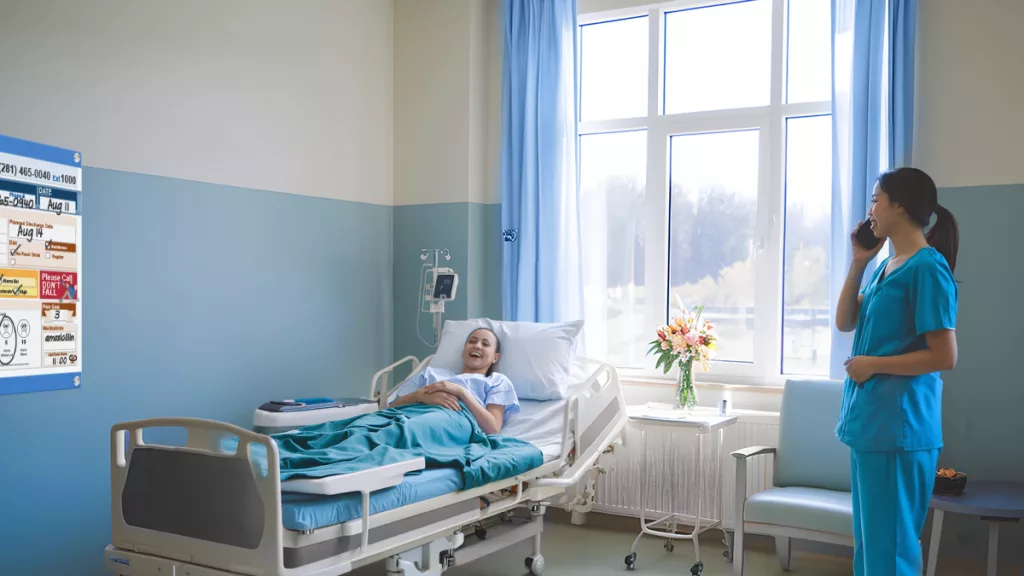
A whiteboard gives patients and families a single place to see care team names, the plan for the day, and key goals at a glance. Rather than relying on memory or a rushed verbal handoff, everyone in the room shares the same reference point.
Bridging Language Barriers
Visual information supports patients who don’t speak English fluently. Names, simple goals, and clear sections reduce reliance on spoken updates alone, helping key patient information remain understandable and helping more patients understand their care and feel included in it.
Boards can also communicate safety alerts such as allergies or falls more clearly to patients and families.
Continuity Across Shifts
When a new nurse or care technician enters the room, the whiteboard offers an instant snapshot of the patient’s status, goals, and multidisciplinary care contributions across shifts. This continuity reduces repeated questions, smooths handoffs, and keeps care moving in the same direction across every shift, ensuring everyone is working from the same current plan.
Empowering Patient Engagement for Patients Health
A whiteboard invites patients to participate. When they can see their goals and care plan, they’re better equipped to ask informed questions and speak up about their priorities—an important driver of both satisfaction and safety.
The Link Between Nurse-Patient Communication and HCAHPS
For hospital administrators and Directors of Nursing, the connection between communication and survey performance is hard to ignore. The HCAHPS survey includes domains for communication and responsiveness of staff—two areas where patient room whiteboards can make a measurable difference.
When patients clearly understand their care team and plan, they’re more likely to rate communication favorably. Transparency builds trust, and trust shows up in the numbers. A patient who knows their nurse’s name and the day’s goal is far more likely to feel heard and well cared for.
That improvement doesn’t stay confined to a single survey domain. Higher communication and responsiveness scores support a stronger overall HCAHPS performance, which in turn influences star ratings and hospital reputation. A low-cost tool that touches both patient experience and public reputation is a rare find in healthcare operations.
Best Practices to Maximize Communication Impact
A whiteboard only works if it’s used well. An outdated or cluttered board can undermine trust just as quickly as a well-maintained one builds it. These best practices help clinical teams get the most from every board.
- Keep information current: Update boards each morning and during rounds, with clear ownership for each update so accountability stays consistent across shifts. An incorrect date or an old nurse’s name signals inattention and erodes confidence.
- Include a daily goal: Add a simple prompt like “What is the most important thing we can do for you today?” to invite patients into the conversation, and list testing schedules so patients can anticipate their day.
- Track hourly rounding: A simple checkmark system reassures patients that check-ins are happening on schedule.
- Make boards usable: Attach a marker holder, keep markers and erasers easy to reach, and position the board within the patient’s line of sight. Small design choices matter for keeping the board useful day to day.
- Support staff adoption: Embed whiteboard updates into existing routines, such as morning assessments and nurse leader rounds, so the task doesn’t feel like extra work.
Consistency is the thread that ties these practices together. Standardized templates—tailored by unit for ICU, pediatrics, or med-surg—make it easier for staff to update boards quickly and for patients to know where to look.
Measuring Communication Improvement
To justify investment and sustain adoption, clinical leaders should treat whiteboards as a measurable initiative, not a one-time install.
Start by tracking communication-related HCAHPS scores before and after standardizing whiteboard use, while also measuring patient satisfaction and understanding to evaluate communication quality. A clear baseline makes it easier to demonstrate ROI and identify which units are seeing the strongest gains. Pair this data with nurse leader audits that check board completeness during routine rounds. These audits do double duty: they monitor consistency and reveal where additional staff training may be needed.
Over time, this combination of survey data and direct observation builds a clear picture of how a simple visual tool contributes to safer, more connected care.
Turn Communication Gaps Into Connection
Patient whiteboards are a simple, high-impact tool for strengthening nurse-patient communication. They give patients a clear view of their care, help staff maintain continuity across shifts, and support the kind of transparency that drives HCAHPS performance and patient trust.
The facilities that see the greatest benefit treat whiteboards as part of a system—standardized templates, current information, and staff training that makes consistent use second nature.
Ready to put this into practice? Discover how customizable communication boards can be tailored to your units and workflows to support your communication goals and patient experience scores.
How the Rural Health Transformation Program Elevates Patient Room Signs and Communication Boards From Wall Fixtures to Care Interventions
The Rural Health Transformation Program (RHTP) is a federal initiative focused on strengthening sustainable access to care in underserved communities. It places technology-enabled solutions and measurable care delivery improvements at the center of its model.
Addressing Daily Operational Realities
For rural hospitals facing lean staffing, high patient turnover, and limited training resources, communication gaps are not abstract challenges—they are daily realities. Custom patient whiteboards and glass boards directly address these issues by serving as low-cost, high-impact intervention tools embedded within the care environment.
Embedding Communication Into Workflow
When board information is structured, standardized, and consistently updated—such as care team names, daily goals, discharge timelines, pain management plans, and creating daily care plans that support workflow—it becomes an active part of the clinical workflow rather than a passive reminder. It also helps staff track reassessments and plan updates across the day, including changes noted every few hours.
Supporting Efficiency in Rural Settings
In rural settings where a single nurse may manage multiple patients per shift, a well-designed communication board reduces verbal repetition and supports faster handoffs. It also provides patients and families with a reliable reference point that does not depend on staff availability at any moment.
Simplifying Compliance and Audits
Standardization of whiteboards simplifies audits and supports compliance documentation. This makes it easier to demonstrate measurable outcome improvements, which aligns with the incentives of the RHTP.
A Practical, Scalable Solution
For rural health systems aiming to use funding to align infrastructure investments with program priorities, customizable VisiCare whiteboards and glass boards offer practical options that can be tailored to rural workflows and meet unit-specific communication needs. They strengthen communication, enhance staff efficiency, and place meaningful information directly in front of the patients who need it most.
Frequently Asked Questions
Do whiteboards improve nurse-patient communication?
Yes. Research by Goyal et al. (BMJ Qual Saf, 2020) found that bedside whiteboards can enhance communication between patients and nurses when they are used consistently and kept up to date. They give patients, families, and staff a shared visual reference for care team names, goals, and daily plans.
What is a patient whiteboard?
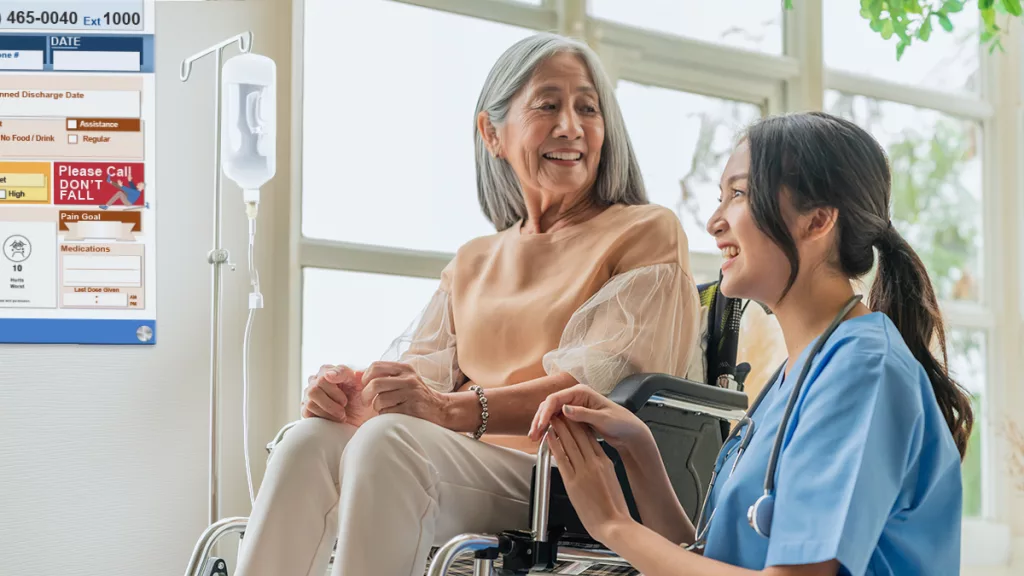
A patient whiteboard, also called a patient room whiteboard or bedside communication board, is a board mounted in a patient’s room that displays key information such as the date, care team names and roles, the daily goal, pain management plans, and hourly rounding updates. Some hospitals also use a digital door display outside the room that pulls updates from EHR systems 24/7, but that is separate from the in-room whiteboard.
How do patient whiteboards affect HCAHPS scores?
Patient whiteboards support the HCAHPS communication and responsiveness domains. When patients clearly understand their care team and plan, they’re more likely to rate communication favorably, which can contribute to stronger overall HCAHPS performance and star ratings.
How can hospitals improve whiteboard adoption among staff?
Embed whiteboard updates into existing routines like morning assessments and nurse leader rounds, provide marker holders and clear templates, and include board checks in leadership audits. Making updates quick and routine minimizes workflow disruption and improves consistency.