
The Link Between Patient Communication and HCAHPS Scores: How Patient Whiteboards Directly Impact Your Scores
HCAHPS scores do more than measure how patients feel. They shape your bottom line. Hospitals in the lowest performance tier can lose up to 2% of their Medicare base payments through Value-Based Purchasing. That’s real money tied directly to how well your teams communicate at the bedside, and it is the clearest link between patient communication and HCAHPS scores: when patients get consistent, visible information about their care, hospitals tend to perform better in survey areas like nurse communication, responsiveness, medication explanations, and discharge information.
Here’s the gap most teams miss: nearly every patient room already has a board on the wall. Yet few hospitals connect the quality and consistency of those boards to their satisfaction outcomes. For hospital administrators, patient experience leaders, operations managers, and clinical teams responsible for patient satisfaction and reimbursement, that missed connection can mean lower scores, more repeated staff questions, and a weaker patient experience.
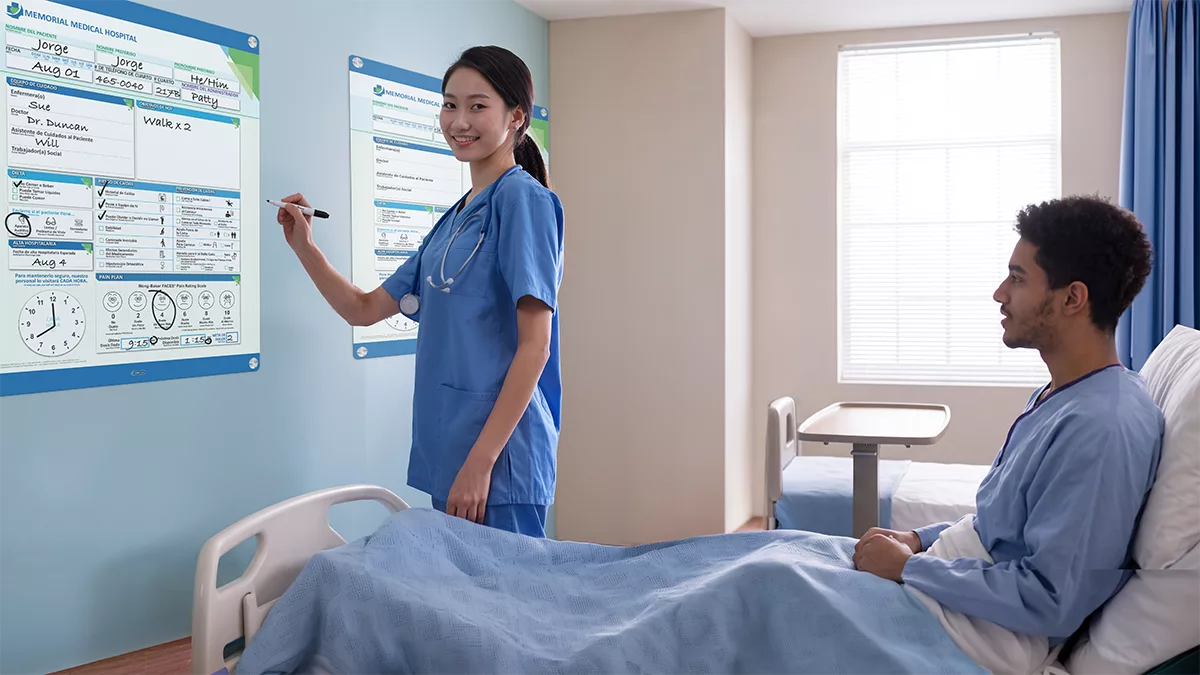
A well-designed Patient Whiteboard sits at the center of the patient communication experience in healthcare settings. These boards, including Hospital whiteboards, glass boards, and patient care boards, serve as frontline communication tools. Key aspects include:
- Influence on multiple HCAHPS domains such as nurse communication, responsiveness, medication explanations, and discharge information.
- Closing communication gaps by providing consistent, clear, and visible information to patients and families.
- Featuring standardized layouts that promote uniformity and ease of use.
- Utilizing durable, readable surfaces like glass to maintain clarity and support infection control.
- Customizable fields aligned with HCAHPS domains to support nursing workflows and patient understanding.
- Enhancing nursing efficiency by reducing repetitive questions and supporting shift changes.
- Serving as a measurable tool to improve patient satisfaction scores and care outcomes.
What Are HCAHPS Scores—and Why Do Boards Matter?
HCAHPS stands for the Hospital Consumer Assessment of Healthcare Providers and Systems. It’s a 29-question survey, publicly reported, and tied to reimbursement through Value-Based Purchasing.
Several survey domains hinge on bedside communication:
- Communication with Nurses
- Responsiveness of Hospital Staff
- Communication about Medicines
- Discharge Information
Here’s the core argument: a patient room whiteboard is the one tool in the room designed to address all four of these domains at once.
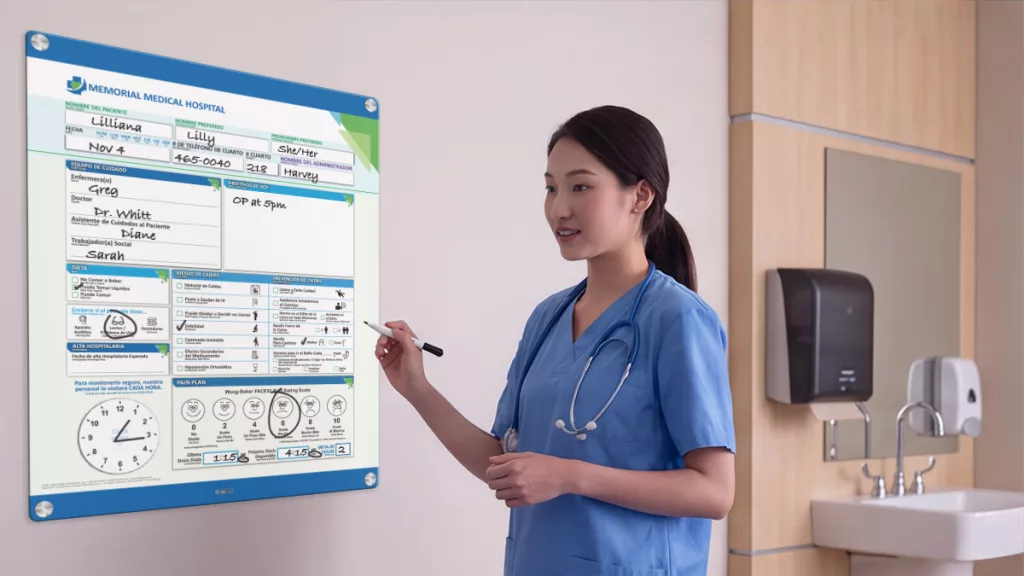
An effective Care board communicates:
- Care team names and roles
- Daily goals and the care plan
- Medication updates
- Discharge date and next steps
- Fall risk and safety alerts
One surface. Four survey domains. That’s leverage most procurement teams overlook.
The Communication Gap That’s Hurting Your Scores
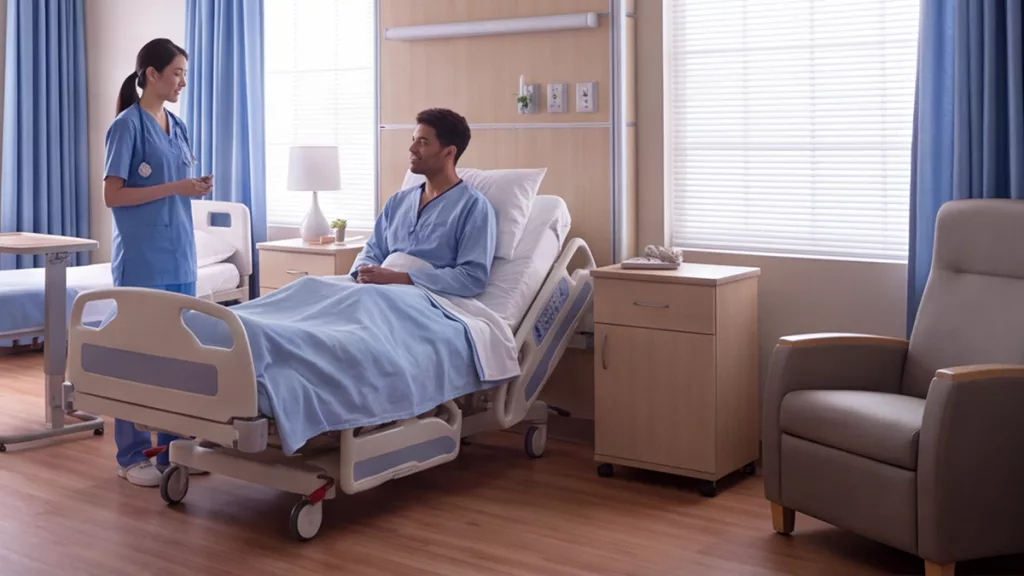
Walk your units and look closely. Faded boards. Blank boards. Boards that read differently in every room. Each one creates confusion for patients, families, and staff.
Consider what that confusion costs:
- Patients who don’t know who their nurse is feel less cared for—and that feeling shows up in the survey.
- Families who can’t find discharge details ask more questions, pulling nurses away from care.
- Boards that vary room to room quietly undermine the sense of organized, coordinated care.
Research consistently shows that patients who feel informed about their care report more positive hospital experiences. Clear information isn’t a courtesy. It’s a driver of measurable outcomes.
The fix isn’t simply filling in the board. It’s having the right board in the first place.
How the Right Patient Communication Board Closes the Gap
Purpose-built Patient communication boards for nursing staff reduce the ambiguity that drags down HCAHPS responses. Three features map directly to survey performance.
1. Standardized Layouts
Pre-printed fields eliminate the blank-slate problem.
- Every room tells the same story.
- Staff update boards faster because the format never changes.
- Patients understand what they’re looking at in seconds.
Consistency is the quiet win here. When boards look the same unit-wide, care feels coordinated—and coordination is exactly what patients reward on the survey.
2. Readable, Durable Surfaces
Ghosting and staining on worn boards make critical information hard to read. That defeats the purpose entirely.
Hospital Glass Boards hold their clarity through years of heavy daily use and repeated disinfection. The surface stays crisp, so the message stays readable.
For a full breakdown of surface durability, infection control, and total cost of ownership, see , “Glass Boards vs. Blank Melamine Dry Erase Boards: Which Is Right for Your Hospital?“
3. Custom Fields Aligned to HCAHPS Domains
Experienced Custom patient whiteboard suppliers can pre-print fields for goals, medications, discharge dates, care team names, and written instructions that support the teach-back method—the very topics patients answer questions about.
Teach-back improves patient understanding of health information and can reinforce adherence to treatment.
Boards designed around real nursing workflows get updated more consistently. That consistency sustains communication accuracy across every shift, which is what the survey ultimately captures. Clearer discharge instructions can also reduce 30-day readmission rates.
Patient Room Whiteboard Ideas for Hospitals: What High-Performing Units Do Differently
The best-performing units treat their boards as care tools, not decoration. Here are practical Patient room whiteboard ideas for hospitals that support HCAHPS performance.
| Board Section | HCAHPS Domain Supported |
|---|---|
| Nurse and care team names + photo space | Communication with Nurses |
| Daily care goals and medication notes | Communication about Medicines |
| Discharge date + next steps | Discharge Information |
| Pain level scale | Responsiveness of Staff |
| Fall risk indicator | Patient Safety |
A few principles separate strong boards from forgettable ones:
- Co-design with nursing staff. Adoption rates climb when boards reflect how nurses actually work.
- Keep the layout scannable. Patients and families should find any answer in a glance.
- Build in modular updates. Magnetic elements let teams adjust shift-specific details without rewriting the whole board.
Small design choices, made with the end user in mind, drive higher staff adoption and clearer patient understanding.
Care Boards as a Nursing Staff Efficiency Tool
Satisfaction scores get the headlines, but Directors of Nursing and clinical managers care about workflow too. A good Patient care board delivers on both.
Consider the efficiency gains:
- Boards anchor key data visually, reducing repetitive verbal handoff errors.
- Standardized layouts cut the time nurses spend answering the same patient and family questions.
- Surfaces that are easy to write on and wipe clean get updated more often—surface quality directly shapes nursing compliance.
Hospital whiteboards also work as a shift-change tool, not just a patient-facing display. A well-built board keeps the incoming team oriented in seconds.
The relationship is simple: when boards work for nurses, they work for patients. And that relationship is exactly what HCAHPS measures.
Choosing the Right Board for HCAHPS Improvement
Ready to spec a board that moves your scores? Use this checklist as your buying framework.
- ✅ Does the layout include fields for all key HCAHPS communication domains?
- ✅ Is the surface durable enough to stay readable after daily disinfection?
- ✅ Can the board be customized to match your unit’s specific workflow?
- ✅ Will staff actually update it—does the format reduce friction rather than add it?
- ✅ Does your Custom patient whiteboard suppliers partner offer design consultation, not just product fulfillment?
Surface choice deserves special attention. Glass and melamine differ sharply in durability, infection control, and long-term cost—factors that affect both readability and ROI.
The Bottom Line
HCAHPS scores reflect patient experience. And patient experience begins with how clearly and consistently patients are informed. A well-designed Care board built on a durable surface is a direct, measurable lever for improvement.
Start with three practical steps:
- Audit your current boards. Are they readable, consistent, and updated across every shift?
- Map your weak spots. Identify which HCAHPS domains score lowest, then prioritize matching fields on your boards.
- Consult a specialist. Work with a supplier that designs boards around your nursing workflows and communication goals.
Better boards mean clearer communication, stronger staff efficiency, and higher satisfaction scores—a smart, cost-effective investment in the tool your teams use most.
Ready to turn the most-used surface in every patient room into an HCAHPS advantage? Visit VisiCare.com to request a design consultation or a board audit, and build Hospital whiteboards your teams will actually use.