
Do Patient Communication Boards Deliver Real ROI? Here’s the Data
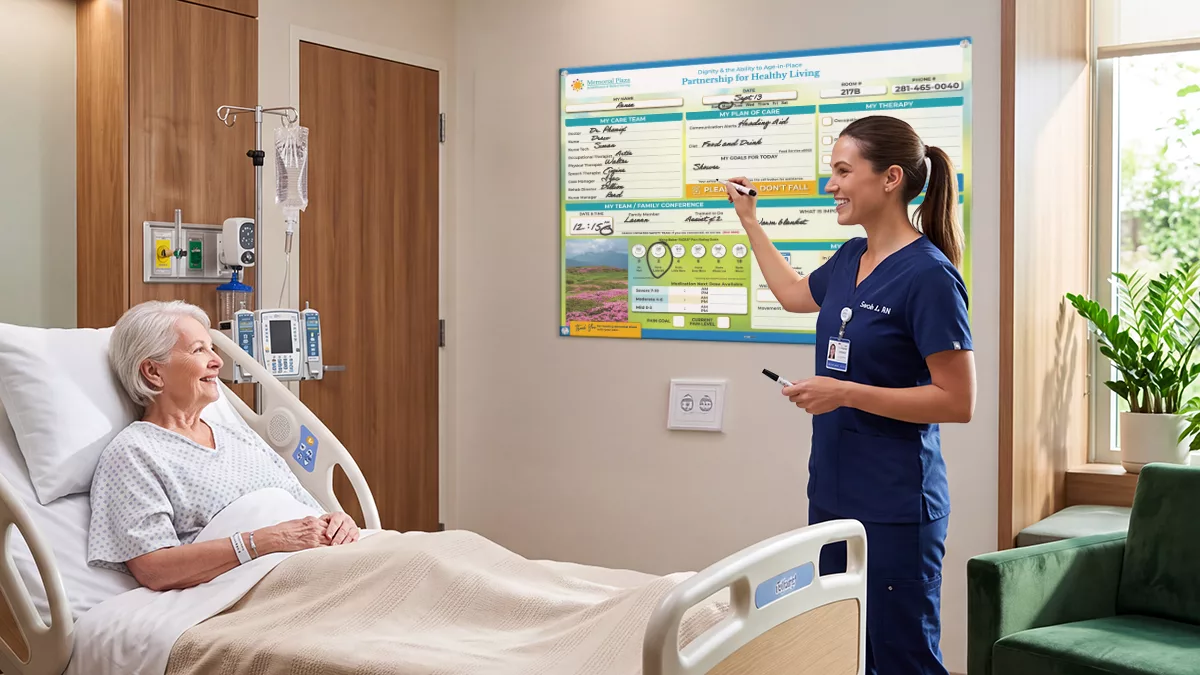
Hospitals pour resources into staffing, technology, and infrastructure—yet one of the most-used tools in every patient room rarely makes it onto the performance review agenda. Patient communication boards are updated every shift, seen by every patient and family member, and touched by nearly every nurse on the floor. Despite this, procurement teams frequently treat them as fixtures rather than functional assets.
That gap in thinking has a cost. Poor-quality patient whiteboards contribute to lower HCAHPS scores, reduced Medicare reimbursements, and measurable inefficiencies in nursing workflows. When boards are worn, inconsistent, or poorly designed, the effects compound quietly—one missed update, one confused family member, one avoidable question at a time.
This post exists to close that gap. It presents a practical ROI framework for hospital administrators, Directors of Nursing, and procurement leaders who want to evaluate patient communication boards with the same rigor they apply to other facility investments. The framework covers three pillars: reimbursement impact through HCAHPS performance, staff efficiency gains, and total cost of ownership. By the end, you’ll have a clear methodology for building an internal ROI case—and a checklist for what high-performing board programs actually look like.
Why ROI Conversations Around Patient Communication Boards Are Overdue
For the purposes of this post, “patient communication tools” refers specifically to bedside communication surfaces: patient whiteboards, patient information boards, bedside whiteboards, and hospital glass boards. These are not digital dashboards or EHR integrations. They are the analog, shift-by-shift communication layer that sits in every patient room, every day, surfacing important information for patients, families, and other hospital staff.
That frequency matters. A board updated three times per shift, across 300 rooms, generates hundreds of daily touchpoints with patients and families. These boards serve as a communication board layer inside the healthcare environment and can be adapted to specific needs. Good boards compound that interaction positively—reinforcing trust, reducing confusion, and supporting better patient satisfaction and patient care outcomes. Worn, ghosted, or inconsistently formatted boards compound it negatively.
If you’re new to how boards connect to survey performance, start with our post: The Link Between Patient Communication and HCAHPS Scores: How Patient Whiteboards Directly Impact Your Scores
The ROI conversation around these tools breaks into three distinct pillars:
- Reimbursement impact — how board quality influences HCAHPS scores and, by extension, Value-Based Purchasing payments
- Staff efficiency gains — the operational time recovered when communication is clear, standardized, and reliable
- Total cost of ownership — what boards actually cost when you account for replacement cycles, procurement administration, and infection control risk

Pillar 1: How Do Patient Information Boards Connect to HCAHPS Reimbursement?
HCAHPS scores are publicly reported and tied directly to CMS Value-Based Purchasing (VBP) reimbursements. Hospitals in the lowest performance tier can lose up to 2% of their Medicare base payments—a significant figure for any facility operating on thin margins.
Four HCAHPS domains are most directly influenced by what appears on a bedside whiteboard:
- Communication with Nurses — supported by displaying care team names and roles
- Communication about Medicines — supported by documenting medication notes and daily care goals
- Discharge Information — supported by showing estimated discharge date and next steps
- Responsiveness of Hospital Staff — supported by pain scale tracking and safety alerts
A well-designed patient information board addresses each of these domains in a single, visible format. The board doesn’t replace nursing communication—it reinforces it. When a patient sees their nurse’s name, their discharge plan, and their daily goals clearly displayed, they are more likely to report feeling informed and cared for when survey time comes.
Pillar 2: What Efficiency Gains Do Bedside Whiteboards Actually Deliver?
The reimbursement argument resonates with finance teams. The efficiency argument resonates with Directors of Nursing, nurses, doctors, and other healthcare professionals—and it’s equally compelling.
Well-designed bedside whiteboards reduce operational friction in four measurable ways:
- Fewer repetitive questions per shift — when care team names, goals, and discharge plans are visible, patients and families ask fewer orientation-type questions
- Faster, more accurate handoffs — standardized board layouts give oncoming nurses a reliable reference point, reducing the time needed to establish care context
- Lower cognitive load — when nurses don’t have to mentally track what information is posted where, they can focus on higher-acuity tasks
- Fewer verbal communication errors — outdated or missing board information is a documented source of miscommunication between patients, families, and care teams
They also support collaboration by keeping schedules and daily plans visible.
A straightforward internal measurement approach: track the average time nurses spend answering orientation questions (who’s my nurse, what’s the plan today, when do I go home) before and after a board upgrade. A reduction of even five minutes per nurse per shift, across a 20-nurse unit, adds up to over 36,000 minutes—or 600 staff hours—recovered annually.
Automated digital solutions linked with Electronic Health Records can save staff time, but this article is focused on the bedside board layer.
The best dry erase boards for patient rooms are ones that reduce friction at every step: easy to write on, easy to clean, and easy to read from across the room. When a surface resists the marker, ghosts previous entries, or requires extra effort to erase, staff skip updates. Lower update compliance translates directly to lower ROI, especially when staff lack convenient access to markers.
Signs your current boards may be hurting staff efficiency:
- Ghosting that makes previous entries partially visible
- Inconsistent layouts from room to room, requiring nurses to re-orient at every handoff
- Staff routinely skipping board updates because the surface is worn or difficult to use
- Family members flagging outdated information during rounding
Pillar 3: How Does the Total Cost of Ownership Compare for Hospital Glass Boards vs. Melamine?
The most common procurement objection to upgrading patient communication boards is straightforward: hospital glass boards cost more upfront. That objection deserves a direct response—but it also requires the right frame.
Upfront price is not total cost. TCO is.
Here’s how the comparison breaks down over a 10-year period for a 50-room unit:
Melamine boards
- Lower initial unit cost
- Require replacement every 2–3 years under standard clinical use
- Over 10 years: 3–5 replacement cycles per room
- TCO = unit cost × 50 rooms × 3–5 cycles + procurement administration time
Hospital glass boards
- Higher initial unit cost
- Built to last 8–10+ years with consistent surface performance
- Over 10 years: single purchase, minimal maintenance
- TCO = unit cost × 50 rooms, once
When procurement teams model this comparison honestly, glass boards frequently outperform melamine on a per-year basis—sometimes significantly. And that calculation doesn’t yet account for the hidden costs: the staff time spent identifying and ordering replacements, the administrative overhead of managing multiple procurement cycles, and the inconsistency that occurs during transition periods when some rooms have new boards and others don’t.
There’s also an infection control dimension. Hospital glass boards feature non-porous surfaces that wipe down cleanly with standard disinfectants. Worn melamine, by contrast, develops surface degradation over time that creates micro-abrasions where contaminants can accumulate—a risk that’s difficult to quantify but very real in high-acuity environments.
For a detailed side-by-side analysis of durability, infection control performance, and long-term value, see Glass Boards vs. Blank Melamine Dry Erase Boards: Which Is Right for Your Hospital?

Building Your ROI Case: A Framework for Procurement Teams
Once the three pillars are understood, the next step is building an internal case. Here’s a practical five-step framework:
Step 1 — Audit current board performance Assess readability, layout consistency across rooms, line of sight, and wall placement, along with the current replacement cycle. Document how often boards are being updated per shift and flag units with the highest rate of ghosting or staff workarounds.
Step 2 — Identify your HCAHPS baseline Pull current scores for the four domains most influenced by bedside communication: Communication with Nurses, Communication about Medicines, Discharge Information, and Responsiveness of Staff. Map your current VBP tier and calculate the reimbursement exposure of remaining in it.
Step 3 — Calculate staff efficiency opportunity Estimate the average time lost per shift to communication gaps that a board update would address. Apply that figure across your nursing staff and annualize it. Even conservative estimates often reveal hundreds of recoverable hours.
Step 4 — Model TCO over 5–10 years Compare your current replacement cycle costs against the projected cost of a glass board investment. Include procurement administration time and any infection control risk in your melamine estimate.
Procurement should also evaluate the available size range, including five standard sizes of patient communication boards and custom sizes when units have specific needs.
Step 5 — Define your success metrics Set measurable targets before implementation—HCAHPS domain improvement thresholds, board update compliance rates, and staff satisfaction with tools. Schedule formal reviews at 6 and 12 months post-installation.
One additional variable worth noting: custom patient whiteboards designed around actual nursing workflows consistently outperform generic layouts on both adoption and update compliance. When the board reflects how care actually flows on a given unit, staff use it. When it doesn’t, they work around it—and ROI erodes accordingly.
Procurement teams should create layouts around workflow, not just buy a standard template.
What High-ROI Board Programs Have in Common
Facilities that see measurable returns from their board investments tend to share a consistent set of practices. Use this as a checklist when evaluating suppliers of hospital glass boards or medical dry erase boards:
- Standardized layouts across all units — not left to individual staff interpretation, which creates inconsistency and reduces handoff efficiency
- Surface quality that holds up to daily disinfection — glass is the preferred option for high-use units; it maintains performance without degradation
- Co-design with nursing staff — boards should be built around how care actually flows on each unit, with the supplier acting as a dedicated partner to nursing leadership to drive higher adoption rates
- Regular audits to maintain update compliance — ROI erodes when boards go stale; auditing helps keep important information current without disrupting patient rest
- A vendor relationship that goes beyond product fulfillment — design consultation, workflow review, and ongoing support distinguish high-performing programs from one-time purchases
Turn Your Boards Into a Measurable Investment
Every patient room in your facility already has a board. The question is whether that board is helping patients express needs and questions—or quietly costing the facility in satisfaction scores, staff time, and replacement spend.
The three pillars covered here—HCAHPS reimbursement impact, staff efficiency gains, and total cost of ownership—provide a structured way to answer that question with data rather than assumptions.
Three immediate next steps for administrators and procurement teams:
- Audit your current boards for readability, layout consistency, and replacement history
- Map HCAHPS domain performance to current board design gaps
- Contact VisiCare for a consultation to spec boards built for your specific workflows and unit goals
For facilities comparing formats, digital displays can match hospital aesthetics and be ADA compliant.
Visit VisiCare.com to request a board audit or design consultation—and start treating your most-used communication tool as the performance asset it is.
Frequently Asked Questions
How do patient communication boards affect HCAHPS scores?
Patient communication boards directly support four HCAHPS domains: Communication with Nurses, Communication about Medicines, Discharge Information, and Responsiveness of Hospital Staff. When boards are consistently updated with care team names, medication notes, discharge dates, and pain scale information, patients report feeling better informed—which improves survey scores. Higher scores in these domains can meaningfully affect a facility’s Value-Based Purchasing reimbursement tier.
How do I measure the ROI of upgrading patient whiteboards?
ROI measurement involves three components: (1) estimating the reimbursement value of HCAHPS score improvements tied to better board communication, (2) calculating staff hours recovered by reducing repetitive patient questions and improving handoff efficiency, and (3) modeling total cost of ownership across replacement cycles. A five-step internal audit framework—covering board performance, HCAHPS baselines, staff efficiency, TCO modeling, and success metrics—gives procurement teams a structured path to build that case.
Are hospital glass boards worth the higher upfront cost?
For most high-use clinical units, yes. Melamine boards typically require replacement every 2–3 years under daily clinical use, while glass boards last 8–10+ years with consistent surface performance. Over a 10-year period for a 50-room unit, the total cost of ownership for glass boards frequently equals or undercuts the cumulative cost of multiple melamine replacement cycles—especially when procurement administration time and infection control risk are factored in.
What are the signs that current patient room boards are hurting staff efficiency?
Common indicators include ghosting that leaves previous entries partially visible, inconsistent layouts from room to room that require nurses to re-orient at every handoff, staff routinely skipping board updates because the surface is difficult to write on or erase, and family members flagging outdated board information during rounding. These are workflow friction signals—and each one reduces the return on your current board investment.
How do I order medical dry erase boards for a hospital unit?
The most effective approach is to work with a healthcare-specific board vendor that offers design consultation as part of the process. A vendor like VisiCare can help create a board program tailored to unit-specific needs. VisiCare partners with nursing staff to develop custom layouts that reflect actual unit workflows, with standard sizes available as well as custom sizing, then manages production and installation. To order medical dry erase boards or request a design consultation for your facility, visit VisiCare.com.