

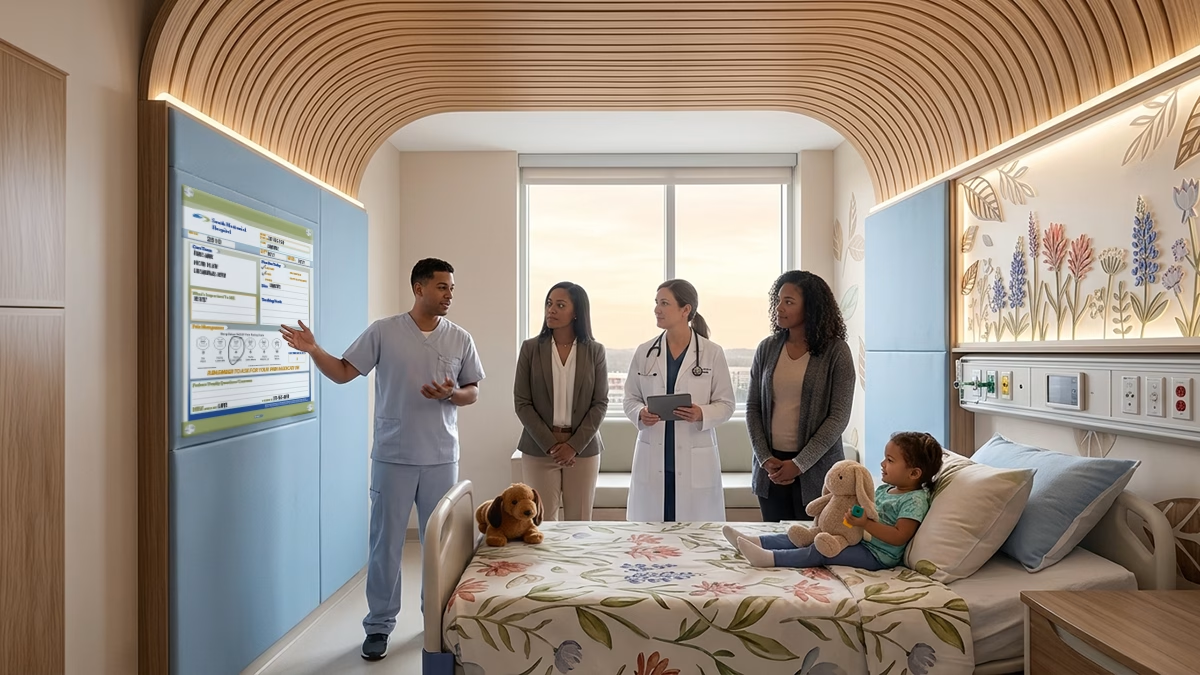
Family-Centered Design in Pediatric Hospitals
For a Nurse Director shaping policy across pediatric units, family-centered design is a systems decision—not a furnishing choice. When rooms treat caregivers as care partners rather than visitors, children experience less anxiety, care plan adherence rises, and satisfaction scores climb. This article lays out what family-centered design means clinically, how to design rooms that both accommodate and engage families, how pediatric whiteboards support caregivers, how to select durable and compliant products, and how to tie it all to measurable outcomes your organization already tracks.
A parent hasn’t left the bedside in three days. They’re sleeping upright in a rigid chair, unsure where to store their belongings or how to stay part of the care conversation. Now picture that same scenario replicated across every pediatric room in your service line. The room either supports that parent or quietly works against them—and at the scale you oversee, “quietly” adds up to a measurable pattern in your adherence data, your call light volume, and your satisfaction scores.
When families are treated as visitors rather than care partners, children experience more anxiety, care plan adherence drops, and satisfaction scores suffer. The physical room sets that tone before your staff say a word. That’s why family-centered pediatric care design belongs in your policy conversations, not just your renovation budget—it’s a decision that touches outcomes across every unit you’re responsible for.
This is the fourth and final article in a series on pediatric room solutions. For the complete strategic framework, see Pediatric Room Solutions for Modern Children’s Hospitals. Here, the focus is on what family-centered design means clinically, how to design rooms that accommodate and engage families, how communication tools support caregivers, how to select products that hold up over time, and how to measure the return. The thesis is straightforward: family-centered design is a clinical and operational investment with returns you can defend to any committee.
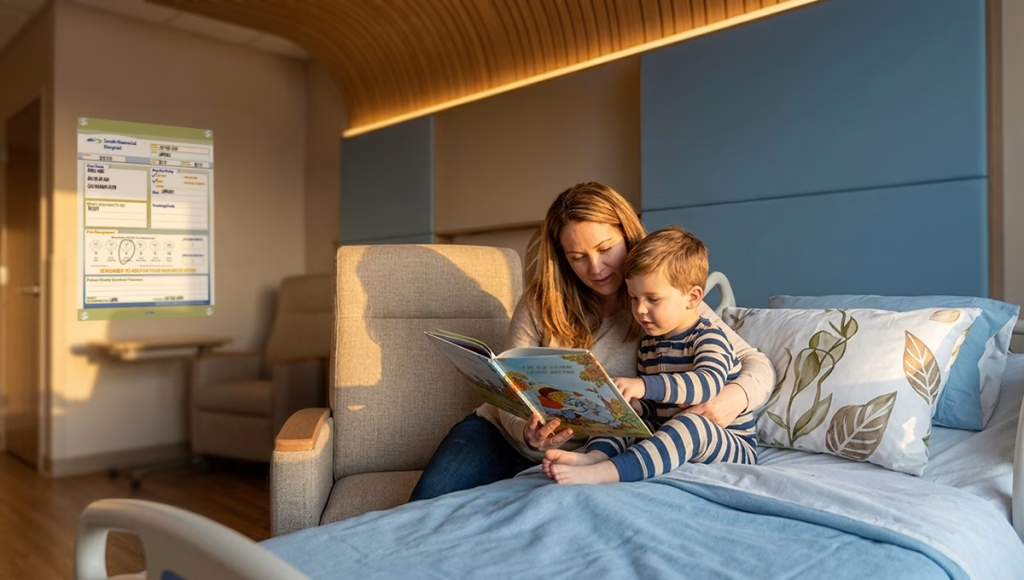
What Does Family-Centered Design Mean in a Pediatric Family Centered Care Context?
Family-centered pediatric care design is an approach that treats parents and caregivers as active members of the care team—not guests—and shapes the physical room around that role. For a director setting standards across units, the distinction is more than semantic. It changes what you specify, how you audit, and what you hold each unit accountable for.
The clinical grounding is well established. Family presence is associated with reduced child anxiety, better care plan adherence, fewer errors caught early by informed caregivers, and stronger recovery experiences. A parent who understands the plan becomes a second set of eyes at the bedside—one who notices when something looks off between rounds.
This is where pediatric care diverges sharply from adult inpatient design. In adult settings, the patient is typically the sole decision-maker and information recipient. In pediatrics, care flows through the caregiver. A room that sidelines that caregiver undermines the very mechanism that keeps young patients safe and calm.
Each of these connects back to the priorities on your dashboard: patient safety, staff efficiency, regulatory compliance, and satisfaction scores tied to reimbursement.
Director’s takeaway: Family-centered design succeeds when a caregiver can stay, rest, stay informed, and participate—without ever leaving the child’s side.
Designing Rooms That Accommodate Families
Physical accommodation is the foundation. A room that welcomes the whole family unit reduces fatigue, and a rested support system helps create a calmer child experience and smoother care delivery. When you’re setting a standard across multiple units, consistency in these features is what makes the benefit reliable rather than incidental.
The core pediatric patient room design ideas for family accommodation are practical:
- Sleeper accommodations: convertible seating or dedicated sleep surfaces that support overnight and extended stays without leaving family members depleted
- Dedicated family zones: a defined area that keeps caregiver belongings organized and out of the clinical workspace, acknowledges that relatives are interconnected, and supports tools that help balance responsibilities
- Storage and comfort provisions: secure, accessible storage for personal items and amenities built for long stays across diverse family structures, whether parents, siblings, or grandparents
- Privacy and dignity: curtain systems, soundproofing, and layout choices that respect families during difficult conversations and support emotional well being
Respect for diversity is an important principle here, and room features should adapt as needs change over time.
One principle should govern every one of these decisions: family zones must never obstruct staff sightlines, clinical access, or safety protocols. Accommodation and clinical function work together, not in competition. The strongest designs prove both can coexist—and that’s the standard worth writing into your specifications.
There’s a procurement dimension here too. Family furnishings live in a high-use, high-disinfection environment. Anything you specify has to withstand rigorous cleaning cycles and daily wear without degrading. A comfortable chair that can’t survive your infection-control protocol isn’t an amenity—it’s a recurring replacement cost.
Designing Rooms That Engage Families in Care
Accommodating a family means giving them space. Engaging a family means giving them a role in the care conversation. For a director, the goal is not just designing for families but designing with families—and the second is where the clinical return lives, even though it’s the harder standard to build into room design.
Practical engagement strategies include:
- Clear communication access points: positioning that lets caregivers see and reference care information without interrupting workflow, while supporting open, transparent communication so families feel informed
- Line-of-sight to communication tools: whiteboards placed where a seated caregiver can read them easily, since family-centered communication boards can improve dialogue between patients and healthcare providers
- Participation-friendly layouts: room arrangements that let a parent stay present during rounds and handoffs rather than being displaced to a hallway
Participatory design and collaboration with families throughout planning improve care and create better experiences by reducing anxiety and enhancing communication.
The outcomes connect directly to metrics you track. Engaged caregivers ask fewer repeat questions, catch discrepancies earlier, and report higher satisfaction. Across a service line, those small shifts compound into measurable movement in your efficiency and experience data.
For age-appropriate, sensory-aware design that supports both child and family, see Designing Child-Friendly Patient Rooms.
How Pediatric Whiteboards and Communication Tools Support Caregivers
Pediatric whiteboards for children’s hospitals are the shared reference point that keeps caregivers informed and oriented across shifts. They’re also one of the most cost-effective family-centered tools you can standardize across departments—which makes them a practical win when you’re balancing impact against budget.
The caregiver-facing fields that matter most:
- Care team names and roles in approachable, easy-to-read formatting
- Daily goals written in plain, family-friendly language
- A dedicated primary caregiver name field that formally helps staff recognize family members as care partners
- A family communication section for questions, updates, and daily notes
- Discharge milestones so families can plan and prepare
These tools help families respond to changes in the care plan from moment to moment.
The outcome is consistent and measurable: when caregivers can see the plan without asking, trust rises, call light frequency drops, and staff reclaim time for clinical priorities. That last point matters at your level—recovered staff time across units is a defensible operational return.
These tools must stay HIPAA-conscious, antimicrobial, and durable to remain viable in daily pediatric use. A board that ghosts or wears out doesn’t just look worn—it loses the staff trust that drives consistent updates, and the benefit erodes with it.
For a full breakdown of board types, adaptations, and pediatric use cases, see The Role of Communication Boards in Pediatric Care.
Selecting Pediatric Patient Rooms and Room Products That Support Families
For a Nurse Director, pediatric patient room products are long-term operational assets that either support or undermine your family-centered goals. Product standards should reduce cognitive load for family members by making shared tasks easier. The product decision is a policy decision—it sets the standard every unit inherits.
A practical evaluation framework covers five dimensions:
| Evaluation Criterion | What to Look For |
|---|---|
| Durability | Long service life, disinfection-resistant surfaces that are essential for infection control |
| Compliance | Certified safe materials, HIPAA-conscious layouts |
| Customization | Age- and unit-specific, family-focused configurations that work across multiple skill levels and support inclusive, flexible use |
| Consistency at scale | Reliable quality across floors and campuses |
| Vendor Support | Design consultation, proofing, phased installation, ongoing service |
A strengths-based, culturally responsive approach builds on what families already do well rather than correcting deficits. These criteria reflect the core concepts behind family-centered care and the practical realities of pediatric healthcare practices.
Two of these deserve particular weight from your seat. Consistency at scale determines whether a product that works on one unit holds up across an entire department—and that consistency is what lets you audit, compare data, and defend the investment. Vendor support separates a genuine partner from a one-time seller; design consultation, proofing, phased installation, and responsive post-installation service are what keep a rollout on track across a department.
The common objection surfaces in most procurement reviews: “New products will disrupt current workflows.” The answer holds up at scale—well-designed products work within existing systems and require minimal staff training. The brief adjustment period is consistently outweighed by fewer workarounds and stronger adoption within the first weeks of use.
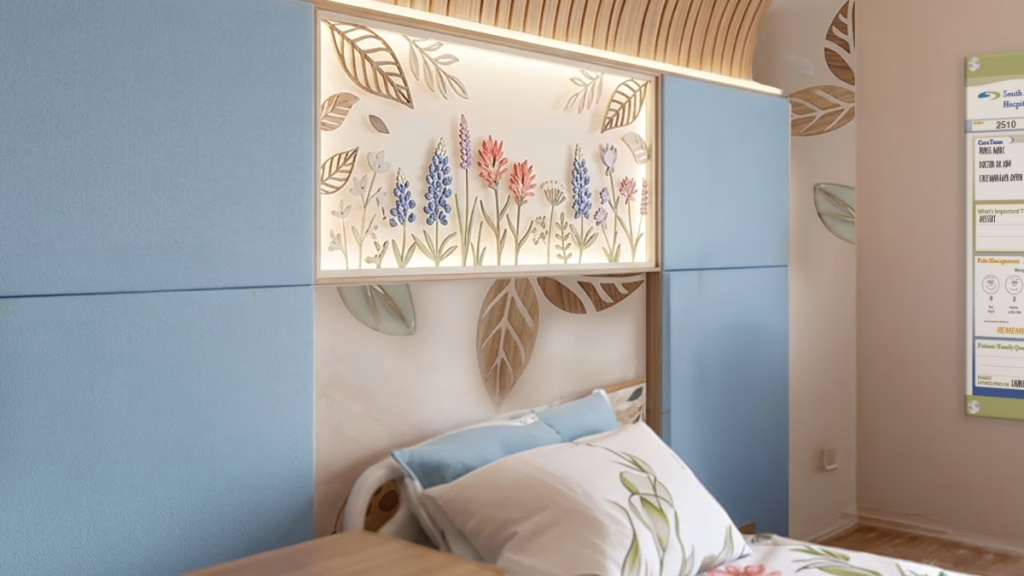
The Measurable Impact of Family-Centered Design
Family-centered design connects to the metrics your organization already watches by improving patient safety and satisfaction in healthcare settings. That connection is what moves this from a comfort initiative to a strategic priority you can present with confidence.
The measurable impacts:
- HCAHPS and satisfaction scores: informed, accommodated families rate communication and overall experience higher
- Care plan adherence: engaged caregivers follow through on instructions more consistently after discharge, supporting treatment and enhancing the health of children with chronic conditions
- Reduced anxiety and faster recovery: a calmer parent supports a calmer child, which can shorten and smooth the recovery experience
- Staff efficiency gains: fewer repeat questions and clearer caregiver communication free your teams for clinical work
The ROI dimension is what makes this a leadership conversation. Higher satisfaction connects to value-based reimbursement, and reduced readmissions tied to better adherence lower long-term costs. Here’s how the investment maps to outcomes:
| Design Investment | Measurable Outcome |
|---|---|
| Sleeper and family zones | Reduced caregiver fatigue, calmer patients |
| Caregiver-facing whiteboards | Fewer repeat questions, higher satisfaction |
| Family engagement layouts | Better care plan adherence |
| Durable, compliant products | Lower replacement and infection-control costs |
When you standardize these elements across units, you gain something equally valuable: the ability to attribute score movement to a specific, defensible intervention rather than guesswork.
For the ROI framework behind communication tools, see Do Patient Communication Boards Deliver Real ROI? Here’s the Data.
Rooms That Care for the Whole Family and Family Members
Family-centered design is a clinical and operational investment with measurable returns in safety, satisfaction, and care adherence. Across a pediatric service line, the units that lead aren’t the ones with the largest budgets—they’re the ones where every room treats the caregiver as part of the care team, consistently, in every space.
The pillars are clear: the clinical meaning of family-centered design, accommodating families, engaging families in care, communication tools that support caregivers, product selection that holds up at scale, and outcomes you can measure. Standardization is the thread that ties them into a working system rather than a scatter of good intentions.
Three next steps you can act on:
- Audit current pediatric rooms across your units for family accommodation, engagement, and communication gaps—and flag the inconsistencies
- Prioritize the highest-impact additions: sleeper accommodations, caregiver-facing whiteboards, and defined family zones
- Evaluate pediatric patient room products against durability, compliance, customization, and consistency criteria before rolling out department-wide
For the complete strategic framework, return to Pediatric Room Solutions for Modern Children’s Hospitals. When you’re ready to build family-centered standards across your units, explore custom pediatric room options or request a consultation with the VisiCare team at VisiCare.com.
Frequently Asked Questions
What is family-centered design in pediatric hospitals?
Family-centered design in pediatric hospitals treats parents and caregivers as active members of the care team rather than visitors, and shapes the physical room around that role. It should feel welcoming for kids and the adults who support them. It includes sleeper accommodations, dedicated family zones, privacy provisions, and caregiver-facing communication tools—all part of a broader set of pediatric room solutions that improve outcomes and satisfaction, while recognizing extended family, including grandparents, when defining who the room should support.
How does family-centered pediatric care design improve outcomes?
Family-centered pediatric care design improves outcomes by keeping caregivers informed, rested, and engaged. Engaged families support better care plan adherence, catch discrepancies earlier, and help children feel calmer—outcomes that are especially important for pediatric patients during treatment and procedures, all of which contribute to smoother recovery, higher satisfaction scores, and fewer avoidable readmissions in a more normal environment that reduces stress.
What pediatric patient room design ideas support families?
Effective pediatric patient room design ideas for families include convertible sleeper accommodations, defined family zones with secure storage, privacy-preserving curtains and soundproofing, and layouts that let caregivers stay present during rounds. Adjacent waiting area planning should also reflect different ages, with separate zones for toddlers and teens, while pathways around furniture remain 1.5–1.8 meters wide to accommodate wheelchairs and strollers across age groups. These features accommodate families without obstructing staff sight lines or clinical access, and the best environments also use sensory-friendly features that benefit all children, natural elements that calm children and adults, and positive distractions such as interactive play areas to reduce stress.
How do pediatric whiteboards for children’s hospitals help caregivers?
Pediatric whiteboards for children’s hospitals give caregivers a shared, always-visible reference point for care team names, daily goals in plain language, a primary caregiver field, discharge milestones, and scheduling clarity around appointments and visits. When families can see the plan without asking, trust rises, call light use drops, and staff reclaim time for clinical priorities. Digital forms completed ahead of arrival can make board-based communication even smoother for families.
How do I choose pediatric patient room products for family-centered care?
Evaluate pediatric patient room products on durability under disinfection, certified safe and compliant materials, age- and unit-specific customization, consistent performance across units, and reliable vendor support that includes design consultation and phased installation. Some family-centered products also support digital intake, which reduces waiting room time for families. Prioritize products that work within existing systems and require minimal staff training. Also consider how centralized support features can make a big difference for family use across units, along with security needs and access to supplies.
Where should I start when making pediatric rooms more family-centered?
Begin with an audit of current rooms against family accommodation, engagement, and communication criteria, reviewing how rooms and nearby amenities work for different age groups and family routines. Identify the highest-impact gaps—often sleeper accommodations, caregiver-facing whiteboards, and defined family zones—then evaluate products and suppliers using a structured framework before piloting on one unit and scaling from there. Some hospitals also use community health programs for adolescents to support smoother transitions beyond the unit. In educational settings, family-centered design can foster better engagement and smoother transitions for students, and flexible planning helps services break down large units into more manageable neighborhoods over time as critical needs evolve.