

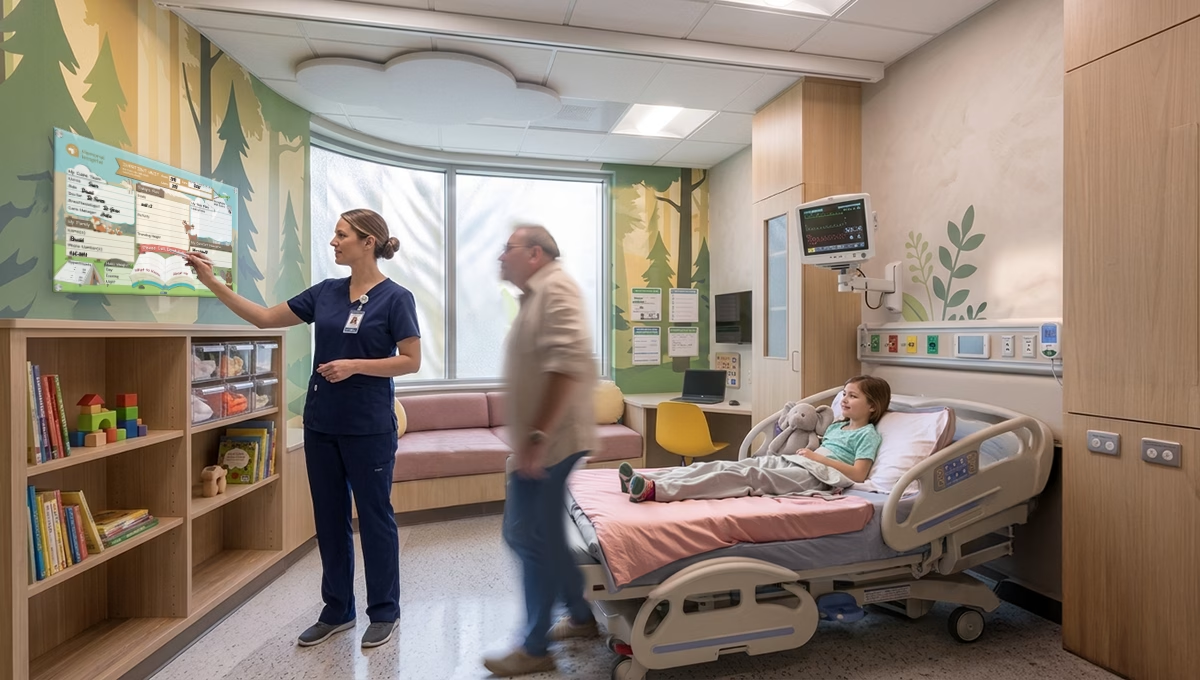
The Role of Communication Boards in Pediatric Care
For a Nurse Director overseeing multiple pediatric units, communication boards are department-wide infrastructure—not room decor. Standardized bedside whiteboards and unit-level nurse boards reduce handoff errors, cut call light volume, and lift the HCAHPS domains tied to reimbursement. This article breaks down how to build board consistency across shifts and units, what pediatric-specific features matter, and how to connect board performance to measurable outcomes.
A parent sits at a child’s bedside, unsure who the nurse is, when the next medication is due, or what today’s goals are. Multiply that moment across every room, every shift, and every unit you oversee—and you can see why board consistency is a department-level problem, not a room-level one. Well-designed pediatric room solutions treat communication boards as the connective tissue that keeps care legible across your whole service line.
This is the third article in a four-part series on pediatric room design. For the complete framework, see Pediatric Room Solutions for Modern Children’s Hospitals. Here, we focus on what matters most from your seat: standardization across units, cross-shift communication reliability, and the measurable outcomes that justify the investment. You’ll learn the clinical role boards play, how pediatric boards differ from adult ones, which features drive value, and how board performance connects to HCAHPS and handoff efficiency.
What Role Do Communication Boards Play in Pediatric Care?
Pediatric communication boards are real-time information hubs that connect the child, the family, and the care team around a shared understanding of the care plan. For a director, their strategic value lies in what they standardize: how information moves across shifts, units, and staff.
The clinical function is concrete. Boards reduce repeated questions, support safe handoffs, surface safety flags like allergies and fall risk, and keep caregivers informed and engaged. In pediatrics, this matters more than in adult care. Children rely on caregivers to interpret and advocate, so the board must serve an adult reader while reassuring a young patient at the same time.
That dual demand connects directly to your priorities: patient safety, staff efficiency, regulatory compliance, and satisfaction scores. When boards vary room to room, you lose the ability to audit, compare, and improve at scale.
Director’s takeaway: A pediatric communication board succeeds when the nurse, the child, and the parent all read it the same way—every shift, in every room, across every unit.
How Pediatric Communication Boards Differ From Adult Hospital Boards
Adult boards assume a single adult patient who reads and retains their own care information. Pediatric boards must serve a developing patient and an engaged caregiver at once. If you’re standardizing across a department, that difference shapes every template decision.
The key adaptations are these:
- Child-adapted pain scales: faces-based or visual scales suited to developmental age, not a 0–10 numeric scale alone
- Family-friendly language: plain-language goals and instructions caregivers understand without clinical background
- Primary caregiver name field: a dedicated space that recognizes the parent as part of the care team, not a visitor
- Family communication section: room for questions, updates, and daily plan notes that keep caregivers oriented
- Age-appropriate visual cues: color coding and icons that reduce fear while staying clinically clear
These adaptations improve the pediatric patient experience while meeting the same safety and compliance standards as adult boards. One point worth clearing up for your teams: a pediatric board is not an adult board with brighter colors. It’s a redesigned communication tool built for two readers—the child and the caregiver.
Board Types: Bedside Whiteboards vs. Unit-Level Nurse Boards
Standardization gets easier when you understand the two distinct board categories and how they complement each other across a unit.
Bedside Patient Whiteboards
Bedside boards are the point-of-care communication hub inside individual children’s hospital rooms. A well-built pediatric bedside board displays care team names and roles, daily goals in family-friendly language, a child-adapted pain scale, the primary caregiver name, medication notes, discharge milestones, allergy flags, and fall risk status.
The operational payoff: consistent bedside board use reduces call light frequency and repeated caregiver questions. For a director, that’s recovered staff time you can measure across units.
Unit-Level Nurse Communication Boards
Unit-level boards serve a different function—organizing information across the entire care team rather than a single patient. They track assignments, flag high-acuity pediatric patients, and support structured shift handoffs.
Documented outcomes include fewer medication errors during transitions, faster response times, and stronger staff accountability. Bedside and unit-level boards work as a connected system: one supports the family, the other supports the team, and together they close the communication gaps that surface at shift change.
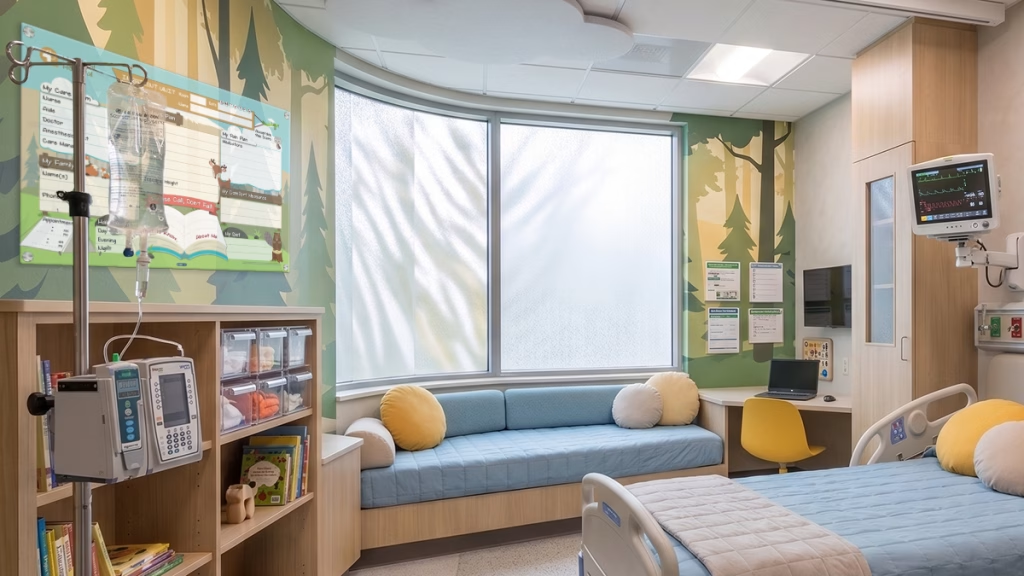
Custom Pediatric Hospital Whiteboard Features That Matter
Treat custom pediatric hospital whiteboards as durable operational assets, not one-time purchases. The features you standardize on determine how well boards hold up—and how consistently your teams use them.
| Feature | Why It Matters |
|---|---|
| Antimicrobial surface | Supports infection control in high-touch settings |
| HIPAA-compliant layout | Structures sensitive information appropriately |
| Durable material | Withstands disinfection without ghosting |
| Customization | Adapts to age group and unit workflow |
| Modular inserts | Evolves with protocols over time |
A few of these carry extra weight at the department level. Durable materials matter because a ghosted, worn board erodes update compliance—staff stop trusting it, then stop using it. Interchangeable graphic inserts let you adapt layouts as protocols, age groups, or unit needs evolve, without replacing the whole board. And customization by unit and age group lets you run infant, school-age, and adolescent configurations within a single facility while keeping a consistent core template.
If you hit the common objection—“new tools will disrupt current workflows”—the answer is direct: boards that integrate with existing systems require minimal staff training, and adoption typically climbs within the first weeks.
For age-appropriate design context, see Designing Child-Friendly Patient Rooms.
How Communication Boards Improve HCAHPS Scores and Handoff Efficiency
This is where board standardization pays for itself. The domains patients and families are asked to rate—communication with nurses, responsiveness of staff, communication about medicines, and discharge information—are all directly supported by a well-maintained board.
The measurable impacts:
- Reduced call light frequency: families find answers on the board without needing to ask
- Faster, safer handoffs: standardized layouts give oncoming staff a reliable reference point
- Fewer communication errors: current, visible information reduces reliance on verbal handoffs alone
- Higher family satisfaction: caregivers who feel informed report a stronger overall experience
The ROI dimension is what makes this a leadership conversation. Higher satisfaction scores connect to value-based reimbursement, and recovered staff time reduces operational strain across your units. When every unit runs the same board standard, you can attribute score movement to a specific, defensible intervention.
For the ROI framework behind communication tools, see Do Patient Communication Boards Deliver Real ROI? Here’s the Data.

How Boards Build Pediatric Patient Experience and Family Trust
Trust is built through visibility. When caregivers can see the plan, the team, and the goals, they feel like partners in care rather than bystanders—and that perception shapes how they rate their entire stay.
The experience impact shows up across shifts:
- Reduced anxiety for both child and caregiver when information is clear and consistent
- A sense of continuity when the board carries the plan forward from one shift to the next
- Recognition of the caregiver’s role through a dedicated name field and family section
The clinical connection matters too. Engaged caregivers support better care plan adherence and calmer, more cooperative young patients. For a director tracking outcomes across a department, consistent board use is one of the most reliable levers you have for improving the pediatric patient experience at scale.
Boards That Speak to Children and Their Families
Across a pediatric department, communication boards are clinical infrastructure with measurable returns in safety, satisfaction, and staff efficiency. The units that perform best aren’t the ones with the most boards—they’re the ones where every board reads the same way, every shift.
The pillars covered here: the clinical role of boards, pediatric-specific adaptations, the bedside-versus-unit-level split, feature selection, HCAHPS and handoff impact, and family trust. Standardization is the thread that ties them together.
Three next steps you can act on:
- Audit current pediatric boards across your units for child-adapted pain scales, family-friendly language, and caregiver fields—and flag the inconsistencies
- Standardize bedside and unit-level board layouts so updates stay consistent and handoffs stay reliable across every shift
- Evaluate custom pediatric hospital whiteboards against durability, compliance, and customization criteria before rolling out department-wide
For the complete strategic framework, return to Pediatric Room Solutions for Modern Children’s Hospitals. When you’re ready to standardize communication boards across your units, explore custom pediatric communication board options or request a consultation with the VisiCare™ team at VisiCare.com.
Frequently Asked Questions
What is the role of communication boards in pediatric care?
Communication boards in pediatric care act as real-time information hubs that connect the child, the family, and the care team. They display care team names, daily goals in family-friendly language, child-adapted pain scales, and safety flags—reducing repeated questions, supporting safer handoffs, and strengthening family trust as part of a broader set of pediatric room solutions.
How do pediatric communication boards differ from adult hospital boards?
Pediatric communication boards for hospitals are built for two readers at once: a developing patient and an engaged caregiver. They include child-adapted faces-based pain scales, plain-language care goals, a primary caregiver name field, and age-appropriate visual cues—adaptations adult board templates rarely provide.
What features should custom pediatric hospital whiteboards include?
Effective custom pediatric hospital whiteboards include antimicrobial surfaces for infection control, HIPAA-compliant printed layouts, durable materials that resist ghosting under disinfection, magnetic and modular options, and interchangeable inserts that adapt to different age groups and unit workflows.
How do communication boards improve HCAHPS scores in children’s hospital rooms?
Communication boards support the HCAHPS domains families rate—communication with nurses, staff responsiveness, medication communication, and discharge information. When boards are consistently updated across children’s hospital rooms, families feel more informed, call light frequency drops, and satisfaction scores rise.
How do communication boards improve the pediatric patient experience?
Boards improve the pediatric patient experience by making the care plan visible and consistent across shifts. When caregivers can see the team, goals, and next steps, both child and parent feel calmer and more involved—supporting better care plan adherence and stronger family trust.
What is the difference between bedside whiteboards and unit-level nurse boards?
Bedside whiteboards serve individual patients and families with care plan details at the point of care. Unit-level nurse communication boards organize information across the whole care team—tracking assignments, flagging high-acuity patients, and supporting structured handoffs. Together they reduce communication gaps and improve staff efficiency.